Book of devi, p.1
Book of Devi, page 1


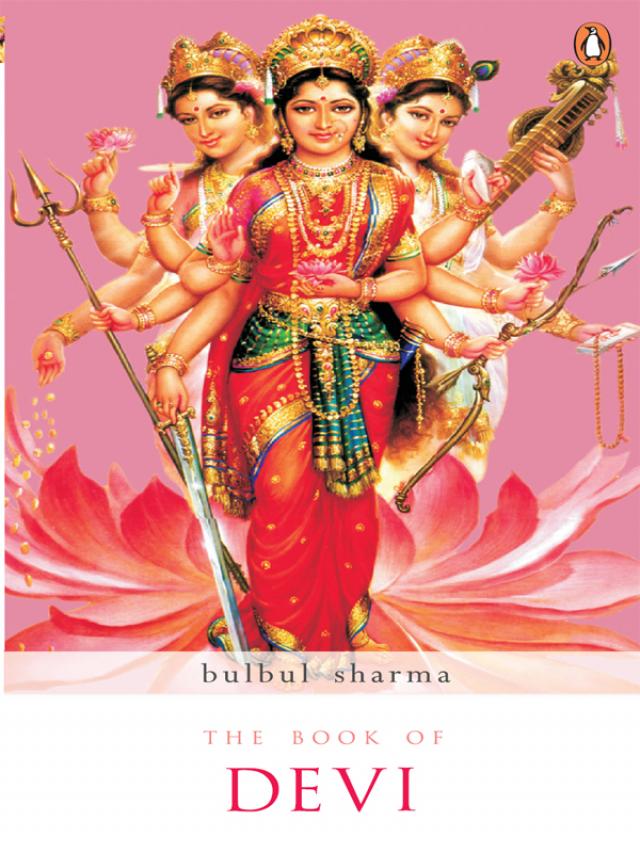
BULBUL SHARMA
The Book of Devi
PENGUIN BOOKS
Contents
Introduction
Durga
Sati
Lakshmi
Saraswati
Sita
Radha
Ganga
Village Goddesses and Minor Deities
Hymn to Aparajita
Bibliography
Books in This Series
The Book of Buddha
The Book of Devi
The Book of Durga
The Book of Ganesha
The Book of Hanuman
The Book of Kali
The Book of Krishna
The Book of Muhammad
The Book of Muinuddin Chishti
The Book of Nanak
The Book of Ram
The Book of Shiva
The Book of Vishnu
Introduction
My search for the Devi began when I was six years old. My grandmother’s chanting would wake me up at dawn and I would crawl out of the mosquito net, walking blindly towards the sound of that faint voice. The pooja room was always lit up by an ancient bedside lamp which cast a rosy glow on the faces of the deities. Everyone was here. A gleaming, bejewelled Kali carved out of granite, a pristine white Shiva, a fiery-eyed Durga, a baby Krishna asleep in his cradle and various other gods and goddesses whom my grandmother wanted to please with her prayers. The pooja room with its collection of tiny silver plates and glasses, miniature beds and lace pillows, sparkling at dawn with jasmine buds which had just been plucked, fascinated me as a child. I would sit outside at the door, since I had not yet bathed, and watch her movements as she did aarti and laid out the bhog. The fragrance of incense would make my head swim and I would inch closer to the marble statue of Radha, hoping my grandmother would give the first prasad to me.
Later as an adult when I began to be interested in mythology, those images lit by the first rays of dawn would repeatedly appear in front of my eyes: Kali’s flashing eyes above the delicate nose glittering with a diamond nose-ring, Durga’s red silk saree with a thin border of gold, Krishna’s plump little hands curled into a fist. They would come into my thoughts not like deities but like living people, with likes and dislikes, complaining of hunger, fatigue and boredom and sharing their everyday joys. I regret not paying more attention to what my grandmother was chanting, not remembering each word of the stories she told me at night. ‘Then came Durga with her four children. Kartika was crying and Ganesha was hungry as usual. Lakshmi sat quietly but Saraswati was grumbling away angrily. What could Ma do? Shiva had, once again, not brought anything to eat today,’ she would say as if it had happened just yesterday and these were not words from a mythical legend centuries old.
Maybe if I had listened more carefully, I would now understand the Devi more. I would not be so confused about the goddess as she changes her forms, the colour of her skin, the expression of her eyes. Uma, Durga, Parvati, Lakshmi and Saraswati, are they one or are they different? When do they separate and when do they merge? Is Saraswati Vishnu’s wife or Brahma’s consort? When does Durga change into Kali?
If I had listened more carefully, I would have known from childhood the Devi’s 1008 names which my grandmother chanted effortlessly each morning, in between giving instructions to the cook. As I read the Devi Bhagavata Purana, make notes from the Devimahatmyam, search for the real Radha and Sita in the epics, I wish I could go back in time to that dimly lit pooja room and listen once more to the chanting. Then I would know why Durga is also called Katyayani; how she turned into Kaushiki in just a fleeting moment; how she slayed the demon Mahishasura. Why was Shiva not invited to Daksha’s great sacrifice? Why did Saraswati leave Vaikunth? These myths were retold over and over again as my grandmother chanted her prayers and sang to herself in that lonely hour of the morning. Her voice was jagged with age and sometimes she just hummed to herself, reciting the verses in her mind, or she would place her spectacles on the tip of her nose and read aloud from a heavy red cloth-bound book. Now, after four decades, I know it was the Bhagavata Purana, a treasure trove of mythological stories.
The two great epics, the Ramayana and the Mababharata and the Puranas have been the source of most of the stories in this collection though I have included some popular folk myths too which are not found in the Puranas. The main Puranas like the Devi Bhagavata Purana sing the praises of the particular god but they also contain stories associated with other gods and goddesses. Many of the legends, like Sati’s sacrifice, are repeated in many of the Puranas but each one has a different ending to it. The lead role is always played by the god in whose praise the Purana has been compiled, while the other gods and goddesses are given minor parts to play. A detailed account of planets, sacred rivers and trees, divine birds and animals associated with the god is also given in the Puranas. The Devi Bhagavata Purana deals mostly with Durga’s powerful image but we meet many other goddesses in the legends. Are they one or are they different? Are they different manifestations of the same goddess? Has their original Vedic image been confused by the later Puranas which abound in extravagant imagery much more suited to popular literature?
The goddesses mentioned in Vedic literature were never as powerful as the gods. For instance Usha, a popular goddess who has been mentioned repeatedly in the Vedas and has many hymns addressed to her, still does not rank as a superior deity. Many of the goddesses like Usha, Aditi and Prithvi from Vedic literature did not survive or were reduced in stature by the time the Puranas were compiled. Saraswati is one of the few goddesses who is mentioned in both Vedic and Puranic traditions as the goddess of learning and wisdom and retains that position even today. Important goddesses like Parvati, Durga, Kali, Radha and Sita are not mentioned in early Vedic literature though they assumed powerful forms later and are worshipped in various temples and other sacred places all over India today.
Durga is the most popular goddess in Bengal and is worshipped annually with great fanfare, while in the north there are shrines in almost every village dedicated to Parvati. Lakshmi reigns in the south as a benevolent goddess and Radha and Sita have a comparatively small but devoted band of followers. Popular tales about these goddesses are recited almost daily in many households, and children get to know them from an early age. Which child would not be fascinated by the wonderful imagery? Fiery-eyed Durga astride a golden lion; Saraswati resplendent in white along with her swan; a glowing Lakshmi seated on a lotus in bloom; and Kali with her frightening garland of skulls. The legends that surround them are told over and over again and soon the children know them by heart. For them, as it is for me, these beautiful lotus-eyed goddesses are not just religious icons but part of one’s family. They laugh and cry, quarrel with each other over petty things, they have fragile natures despite their powerful forms. They are often jealous, angry, greedy and plot deviously against their enemies but still they need to be loved by their devotees. Then they appear, splendid, glorious and benevolent, to dazzle us with their all-pervading light.
Durga
Durga, the great goddess with a thousand names and innumerable forms, appears as Shiva’s consort in many legends, intensifying his attributes. But she is also, unlike most other goddesses of Hindu mythology, worshipped as an embodiment of female energy. She is the formidable Devi and Mahadevi and has many other powerful independent female forms. In a hymn recited by Arjuna in the Mahabharata, her many names are mentioned, ‘… Reverence be to thee, Siddha-Senani, the noble, the dweller of Mandara, Kumari, Kali, Kapali, Kapila, Krishnapingala. Reverence to thee, Bhadrakali; reverence to thee, Maha Kali, Chandi, Chanda, Tarini, Varavarini. O fortunate Kalyayani, O Karali, O Vijaya, O Jaya, younger sister of the chief of cowherds [Krishna], delighting always in Mahisha’s blood! O Uma, Sakambhari, thou art white one, thou black one! O destroyer of Kaitabha! O sciences, thou art the science of Brahma, the great sleep of embodied beings. O mother of Skanda [Kartika], divine Durga, dweller in wilderness! Thou, great goddess, art praised with a pure heart. By thy favour let me ever be victorious in battle.’
There are several accounts of Durga’s origin in the various Puranas. In the Vishnu Purana she arises from Vishnu as his magical force. He calls upon her to help delude a demon king who is threatening to kill the baby Krishna. She takes Krishna’s place in Devaki’s womb, saving him and allowing herself to be killed by the demon. Krishna, an incarnation of Vishnu, promises her that in doing so she would become ‘assimilated to him in glory; she would obtain an eternal place in the sky; be installed by Indra amongst the gods; obtain a perpetual abode on the Vindhya mountains, where meditating upon him (Vishnu) she would kill two demons, Sumbha and Nisumbha, and would be worshipped with animal sacrifices’.
Durga is still represented, as she was centuries ago, as a golden-faced woman of great beauty with ten arms. In her right hand she holds a spear with which she is piercing the demon Mahisha. In her other hands she holds an array of formidable weapons. A lion, her mount, leans against her, its golden mane a contrast to her blood-red saree.
Idols of Durga in Bengal, where she is the reigning deity, depict the goddess with her four children: Lakshmi, Saraswati, Kartika and Ganesha. A small image of Shiva, her consort, is painted above her head. Durga Pooja, an important festival of Bengal and other parts of northern India, is celebrated for nine days in autumn. The central image of Durga slaying the demon Mahisha is installed on the first day and verses from the Devimahatmyam are recited during these nine days. Buffalo and goat sacrifices were once a part of the celebration t hough now a pumpkin is cut as a ceremonial offering. Devotees sing, dance and feast, watched by the benevolent goddess and her family. Popular legends believe she is on a brief visit from her abode in the Himalayas where she lives with Shiva. On the last day of the Durga Pooja, the idol is immersed in the nearest river with a great fanfare of music and dancing to bid the goddess farewell till she returns again the next autumn.
Though Durga Pooja is celebrated in autumn, in some parts of rural Bengal she is also worshipped during spring. The reason for this is found in a legend from the Kalika Purana and Devi Bhagavata Purana, though Valmiki’s Ramayana does not mention it.
Ravana, the king of Lanka, was a great devotee of Durga and worshipped her according to strict rituals every spring. Rama was advised by Narada to invoke the goddess since only she could help him win this battle. ‘Time and again the mighty goddess has come to help the righteous. All the gods in heaven pray to her when they want to defeat their foes. You too shall win this battle and regain Sita, who this evil Ravana has abducted, if you gain the favour of the goddess by worshipping her according to the method that is proper,’ said Narada to Rama. The prince of Ayodhya then performed the pooja in autumn since he could not wait for spring. The goddess transferred her favour fiom Ravana to Rama, helping him win the battle.
While instructing Rama on how the goddess should be worshipped, Narada tells him that the goddess was worshipped by the gods Indra, Shiva and Vishnu when they needed her help to defeat their enemies.
In later centuries too Durga was associated with military success and came to be worshipped by kings before a battle. Shivaji, the great Maratha ruler, is said to have received his sword from Bhavani herself. The founder ruler of Mewar, Bappa, according to a folk legend, received his sword from the goddess. After he had spent many days without food and water, wandering in the forest, the goddess Durga suddenly appeared before him on her golden lion and gave him a lance, a bow, a quiver full of arrows, a shield and a sword—a sword made in heaven by Vishwakarma himself.
The Markandaya Purana lists Durga’s 1008 names. Many of these names are derived from the form she assumes to battle with various demons to save the gods. According to the Skanda Purana the Devi was named Durga because she slew a demon named Durga.
The Devimahatmyam, or the Greatness of Devi, forms a part of the Markandaya Purana. A poem of 700 verses, it is one of the main sources for the mythology of the Mahadevi. This sacred textbook for worshippers of Devi in her forms as Durga, Parvati, Uma and Kali is recited in her temples and is known as the Chandipath. The following prayer is invoked during ceremonies devoted to the Devi:
I resort to Mahalakshmi, the destroyer of Mahishasura, who is seated on the lotus, is of the complexion of coral and who holds in her (eighteen) hands rosary, axe, mace, arrow, thunderbolt, lotus, bow, pitcher, rod, sakti, sword, shield, conch, bell, wine-cup, trident, noose, and the discus Sudarshana.
In this legend from the Devimahatmyam, the goddess, created by the light of three gods—Brahma, Vishnu and Shiva, assumes her most powerful form to slay the buffalo-demon Mahishasura and is thus called, thereafter, Mahishasuramardini.
A war between the asuras and the devas had been on for a hundred years and finally the king of asuras, Mahishasura, defeated Indra and became the lord of heaven. Victorious and full of pride, the king of asuras now assumed the powers of all the devas. He was not only Indra, but Surya, Agni, Chandra, Yama and Varuna. The vanquished devas wandered for a while like helpless mortals and then weary and tired they finally reached Vaikunth to take shelter with Lord Vishnu. ‘See our plight, O lord. The mighty Indra is without his heaven, Surya has no light, Agni has turned as cold as water and Vayu too is still. Look how faded Chandra has become and Yama and Varuna stand before you as helpless as mortal men. Help us, O lord. Destroy this evil Mahishasura who has reduced us to this.’
When Vishnu saw his devas reduced to this sorry state and heard their voices full of sorrow, he was filled with anger. His face trembled and a fierce light shot from his eyes, straight as a lance. Shiva too appeared, enraged, with a great light, and then Brahma came and joined them, his face on fire with intense anger. From the bodies of all the other devas arrows of powerful light and energy shot forth. This combined concentration of light rose like a blazing mountain, its flames lighting up all the three worlds with a unique golden light. And then as the circle of devas watched, the light slowly gathered itself into a lustrous female form.
By that which was Shiva’s light her face came into being, by Yama’s her hair, by Vishnu’s her arms, and by Chandra’s her breasts. By Indra’s her waist, by Varuna’s her thighs, and by earth’s light her hips. By Brahma’s light her feet came into being, by Surya’s her toes, by Agni’s her three eyes were formed and the light of Vayu became her ears. The lights of all other devas too surged forward and they were filled with joy as they beheld the auspicious and beautiful Devi who had been thus formed.
Then Shiva reached for his trident and from it he formed a new trident which he gave to the Devi. Vishnu gave her a discus made from his own discus and Varuna gave her a conch. Agni gave the newly formed goddess a spear, and Indra, the lord of devas, brought out a thunderbolt from his own thunderbolt and presented it to her. Yama gave her a staff from his own staff of death, and Varuna, the lord of waters, gave her a noose. Brahma, the lord of beings, gave her a string of beads and a water-pot, and Surya bestowed his own golden rays on her skin so that the goddess shimmered in her own light. Jewels for her crest, necklaces, earrings, anklets and bracelets were given to her by the devas. Vishwakarma gave her a shining axe and the ocean brought for her garlands of everlasting lotuses. The mountain Himavat gave the Devi a mighty lion to ride on. Glittering with jewels from the milk-ocean, armed with an array of celestial weapons, shining with a divine light, the Devi gave a roar of laughter. As she laughed, stepping out from within the circle of devas, her mighty voice filled the entire sky. She laughed again and again making all the three worlds tremble. The mountains rocked and the seas churned with her terrible laughter. ‘Victory to you!’ cried all the devas in joy and the sages bowed their heads as she walked.
Mahishasura heard the Devi’s footsteps which made the earth quake and looked up to see who was making all this commotion. ‘I am the lord of this universe now. The sky, the earth and the oceans lie crushed beneath my feet. Who dares to make this terrible noise in my presence?’ he said angrily and rushed towards the roar that was filling the sky and the seas. Then he saw her. The Devi stood pervading the three worlds with her lustre. The earth lay curved and bent under her footstep, her glittering diadem scraped the sky.
Then began a battle between the Devi and Mahishasura. The sky blazed as weapons were hurled by the mighty army of asuras. Hundreds of thousands of elephant soldiers, millions of foot soldiers, cavalry and ten million charioteers fought in this great battle. One by one, great asuras surrounded by thousands of croi es of elephants, chariots and horses were sent by Mahishasura to battle with the Devi. They rushed at her with iron maces, javelins and spears. With clubs, swords and axes they tried to kill her. The Devi sat regal and still on her lion, bathed in her circle of unique light. The weapons the asuras hurled at her could not touch her, and she rode her lion through the battlefield, cutting them effortlessly. The lion’s mane shook with rage as they stalked the army of asuras like a fire raging through a forest. While she fought, the goddess played on a battle drum and blew her conch to announce the victory which would soon be hers. Every time she heaved a sigh during the battle it would turn into a battalion of thousand men. The Devi killed hundreds of asuras with her trident, club, showers of spears, swords and stunned thousands of asuras by the noise of her bell and conch. Her swift arrows flew across the battlefield, piercing the asuras till they began to look like porcupines. Some had their heads cut off by her lightning sword while the others were torn into pieces by her axe. The battlefield was soon turned into a mountain of dead asuras, elephants, horses and chariots that had been felled by her. A river of blood flooded the earth as the Devi destroyed the vast army in no time. The generals of the army of asuras, astounded at how their mighty army was being routed, came forward to battle with the Devi, but they too were killed by her.