

Macgregor, p.1
MacGregor, page 1


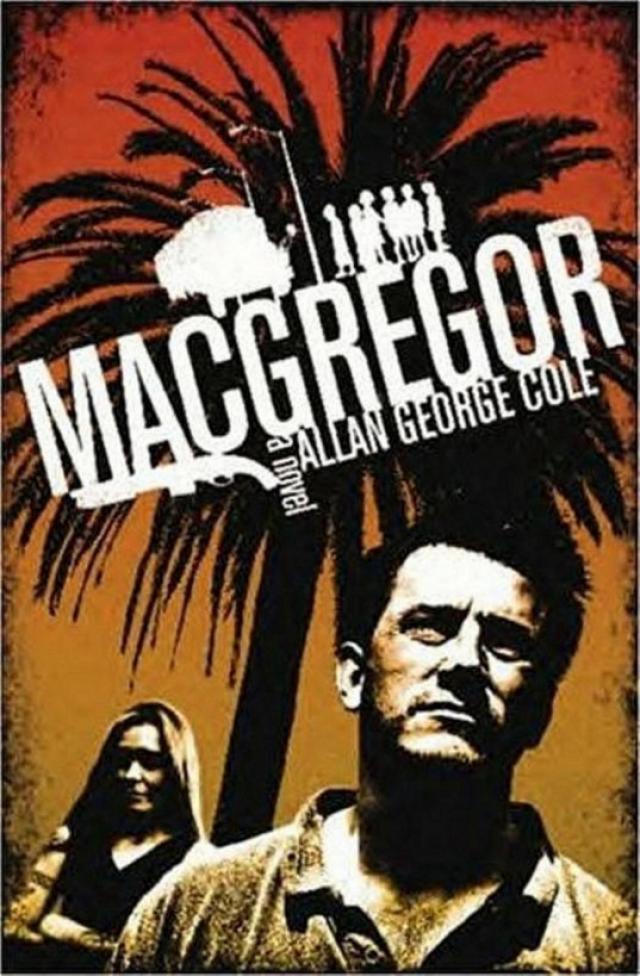
MACGREGOR
By Allan George Cole
* * *
Published By Allan Cole At Smashwords
Copyright 2009 By Allan Cole
Smashwords Edition, License Notes
This ebook is licensed for your personal enjoyment only. This ebook may not be re-sold or given away to other people. If you would like to share this book with another person, please purchase an additional copy for each recipient. If you’re reading this book and did not purchase it, or it was not purchased for your use only, then please return to Smashwords.com and purchase your own copy. Thank you for respecting the hard work of this author.
* * *
For Kathryn
The love of my life
* * *
CHAPTER ONE
THE OLD DUGOUT crashed out of the reeds, sending half-a-dozen swamp hens racing across the lily pads for cover. One of them was too slow, and when the prow butted into it the bird took flight, bursting up into the girl’s face.
As panicked as the bird, the girl swerved, jamming the boat’s broad nose into the hairy roots of a mangrove. She lashed frantically with her paddle, trying to get free. She slapped at the water, the reeds—everything and anything to get unstuck from those roots. The boat swayed this way and that, like a trapped manatee trying to escape the sharp blades of a propeller.
Engines suddenly roared somewhere behind her, and Marie, who was no more than thirteen, stifled a cry then dug deep into the water to finally break free. She back-paddled a few strokes then shot forward, her fear-powered arms making the leaky old boat fly across the lake’s surface like a water skimmer chased by wide-mouthed bass.
The engine roar grew louder and the girl paddled harder, but this time she didn’t panic. Drawing on all her strength, she fought for calm, concentrating on her task. She was a strong little girl—a shrimper’s daughter—and her small hands were calloused and sure from four years at her mother’s side, fixing nets and cleaning shrimp. She kept the dugout straight and true, even though the paddle’s edges were as rough as the old gutting knife her brother put under his bed at night to fend off the tough men who came around to take an honest shrimper’s earnings.
The shore was just ahead, beckoning with its muddy banks and thick tropical foliage that could hide a child like Marie from her pursuers.
Then the airboat crashed out of the reed thicket behind her, riding high and fast over the swamp grass that had tangled her paddle. There was a tough young Latina steering the airboat, and when she spotted Marie she shouted at her boyfriend, a scrawny, sunburned Florida cracker:
“There she is, Tampa.”
Tampa, whose eyes were much sharper than his wits, swiveled his ropy neck, low forehead furrowed under sweat-streaked hair, until he finally fixed on the dugout and the girl.
“Got ‘er, Bonita. Pour it on, honey.”
Bonita poured it on, feeding so much Texaco joy juice to those twin Chevy engines that they lifted the airboat right out of the water and sent it surging after the girl.
Marie heard the airboat closing in but didn’t waste breath crying out. She put her fear into paddling, aiming for that quickly approaching shore. Behind her, Bonita had the airboat moving so fast and so sure that she jumped the vessel over a grassy hummock as smoothly as a big gator going for its prey. Even so, Marie was strong for her size and determined enough for anybody’s size, and she drove that old dugout to shore so hard it jammed into the mud bank.
She didn’t hesitate a second, bounding out of the dugout to hit the ground running. First, she sprinted for the brush that lined the trail. But the brambles were too sharp and thick; and she fell back, sobbing, her bare arms cut and bleeding.
Bonita skidded the airboat into the shore, sending up a wave that nearly sank the dugout. Marie whirled and raced down the dirt path that circled the lake, looking for a way through the heavy foliage.
At the airboat, Bonita throttled back the engines and bumped against the bank. Tampa jumped and scrambled onto the path.
“I’ll cut her off, hon,” Bonita shouted and spun the airboat around to race along the shoreline.
Tampa sprinted after Marie, who was a good fifty yards ahead, his long, skinny legs quickly closing the gap.
Marie heard Tampa’s booted feet getting closer, and she dug into the last of her reserve to put on a burst of speed. Gradually, she pulled away. Off to the side, she heard the airboat skimming along the bank. But Bonita had to stay with the boat and couldn’t get at her.
The girl rushed toward a gnarled log lying across the path. As she started to jump the log suddenly came alive. The front end turned toward her and split in half, exposing enormous rows of white teeth. It was a big gator; and as it turned, it hissed and lashed its tail.
Marie was too scared to scream. She started to back away; then she tripped and, with a small cry, tumbled onto the ground. She heard the hissing gator coming, and then Tampa’s long shadow fell across her.
Marie looked up and saw the skinny redneck draw his .45. He took careful aim at the gator and fired... once… twice. And it was over. The reptile grunted and died.
Tampa leaned over and grabbed the girl by the wrist with his free hand.
“Gotcha,” he said, laughing.
But Marie fought him, kicking and flailing.
“Now cut that out,” Tampa said, shaking her. “Didn’t I just save you from that mean ole gator?”
Marie was far from grateful. She sank her sharp teeth into his wrist, and Tampa howled in pain and fury.
“Goddamn, you little skunk ass,” he bellowed.
He threw the girl to the ground and raised his pistol.
Behind him, Bonita had beached the airboat and was hurrying over to him. She saw what he was about to do.
“Tampa, don’t,” she shouted.
He was so furious he paid her no mind. Tampa fired—Boom! Just like that.
Not one second of hesitation.
Bonita ran up. She looked at Marie’s body. Then up at her redneck boyfriend. She sighed a sigh of weary resignation, and Tampa was suddenly embarrassed. He hung his head. Just like a little boy, she thought.
“Oh, Tampa, sweetie pie,” she said. “What did you do, hon?”
“I couldn’t help it, Bonita, baby,” Tampa whined. “She went and bit me.”
Bonita sighed again. “That just cost us five hundred dollars, baby. Didn’t I tell you we needed a new septic tank for the RV park?”
Tampa started to get irritated. “Okay, okay,” he said. “Geeze, Louise. I hate it when you bug me about money, hon.” He looked down at the girl and shrugged. “Least she won’t bite no more.”
CHAPTER TWO
THE JEEP BOOMED down Ocean Boulevard, stereo blaring a rap song, a topless blonde standing in the seat twirling her bikini top over her head while she whooped and hollered and gave all the drivers a micro-bikini eyeful. She was a South Florida vision to die for. Beside her an earnest young black kid was thinking more about the death part as he squirmed in his seat, hands gripping the wheel, scared spitless and begging the girl to sit the hell down.
“Goddamn, Kim,” he moaned. “We’re supposed to start rehab tomorrow morning.”
But Kim just kept on shaking her stuff. “Come on, Jean.” she shouted. “Last day to party.”
All around her, four lanes of young men leaned out of their cars to cheer Kim on.
“Go, baby, go. Take it all off.” All the while snapping live cell-phone postcards of the wild life, Boca Raton style, to beam home to envious friends.
Horns blared, tires squealed; and more than a few fenders were bent as Kim wriggled to the beat, with only the padded roll bar keeping her from tumbling out.
A police siren howled into life, and Kim’s companion jolted up to see the red gumball light rotating in his rearview mirror.
“Oh, man,” Jean moaned. “Uncle Mac’s gonna shit nickels.”
Then it was instant panic city time as Jean mashed the accelerator and sped away, Boca Raton’s finest in hot pursuit and Kim doing an amazing balancing act, twirling her bikini bra and swiveling her hips.
* * *
A mile or so up the coast, tucked between the Red Reef Golf Course and a million-dollar-a-unit condo complex, was an old beach house. Three weathered stories staggered up the high grassy bluff that bordered South Ocean Boulevard and ran down in a series of dunes to the sea. There were railed sundecks circling each floor of the house, and a wide sundeck planked across the roof.
Across the highway and framing the top story of the house was Spanish River Park, a tropical wonderland of exotic trees and wildlife that included everything from gators, to raccoons, to girls like Kim in tiny bikinis. Except they were soaking up rays for all over tans instead of playing topless go-go girls in Jeeps.
The face of the house was all windows, set in old-fashioned frames that gazed out at the warm seas of the Atlantic. To the left of the stairs were several red-flagged wire barriers, put there to protect sea turtle nests. The posted barriers were required by state and Palm Beach County laws. Few Boca residents objected, just as they didn’t object to the city ordinance requiring all beach dwellers to douse their outdoor lights at night during the hatching season. The lights, it seemed, led the baby turtles astray as they swam for the starry horizons programmed in their genes.
Normally, a sailboard rested in the sand to the right of the stairs, but on this particular day the yellow-and-black-striped board with its opaque yellow sail was swooping gracefully through the surf. It carried a tall, tanned man with an athletic build, dark hair str
This was the “Uncle Mac” Jean had predicted would “shit nickels” when he found out what his wards were up to. He had a lot more names than Mac. Addison Mizner Flagler Titus Broward MacGregor could also be listed. There were others. So many, Mac liked to say, that if they were “laid end to end we’d have one helluva orgy and mass arrest.”
Mac was related to just about everybody who was anybody of historical interest in the state of Florida—from ex-governors to ex-horse thieves. His mother’s maiden name was Mizner—for the Addison Mizner who created Boca Raton out of a swamp and then promoted it shamelessly until it became one of the most exclusive beach communities in the world. Her mother had been a Flagler, after the oil tycoon who had built Florida’s first railroad.
Mac’s late father, Frank MacGregor, was a descendant of a soldier of fortune who in 1817 briefly replaced the Spanish flag in Florida with his own.
Despite this background, Mac was not a man of vast wealth or property. Nor did he covet same. Besides the historic names and the old beach house and its contents, about the only thing of value he possessed was the classic, 1987 YJ Wrangler Jeep that, unbeknownst to him, was racing toward the house with the police in hot pursuit.
Mac shifted position on his board and glanced over at the house, wondering how much time he had before lunch. On the lower sundeck he could see the small figure of Stormy, his housekeeper, and the even smaller figure of her granddaughter, Leslie. The two were energetically sweeping the deck, working their way toward the double patio doors that led into his den.
Good. He had time to play a little longer.
Mac came about, let the wind catch the sail, and bounded over a rolling wave.
* * *
Stormy reached the den then stashed the broom and got out the vacuum cleaner. Leslie was two months past her tenth birthday - the age at which children are either eager to help or eager to hide from anything involving work. Leslie was of the eager-to-help variety and was careful to find all the various tools to the vacuum.
Stormy unwound the cord and handed the plug to the girl.
“Here, honey bun,” she said, “plug it in for your old grandma.”
While Leslie ran to do her bidding, she turned to run a dirt-and-dust-wary eye over Mac’s den. Stormy Nichols was a small, skinny woman of indeterminate age. In the steamy Florida heat, she wore cutoffs and a halter top that showed off the scores of fabulous tattoos that decorated her body. She was an ex-biker princess, a woman with a hard mouth for her enemies and a soft heart for those close to her—with a special warmth for Leslie and Mac.
Mac’s was a fairly typical male domain--dark wood, old-fashioned desk with a new-fashioned computer—an IMac, naturally. One wall was crammed with books, another slathered with framed photographs—mostly of Mac posing with the famous and the infamous, ranging from politicians and entertainment industry stars to sportsmen and business people. The photos weren’t there for mere boasting purposes; they represented how Mac made his living. When potential new clients sought him out, he brought them into the den, where they couldn’t help but notice the pictures, then invited them to offer what they chose for payment.
It wasn’t necessarily money Mac sought, and he made this known right from the start. When it came to money, Mac was a firm believer in his great-uncle Mizner’s adage: “Money, to be worth striving for, must have blood and perspiration on it—preferably that of someone else.”
Besides, Mac thought money was weighted down with too many encumbrances. Money required safekeeping, careful thought, and the continuous acquisition of more. It also required documents that had to be submitted to various governmental bodies and institutions, obligations he detested.
An obligation to another person—a human being—was a different matter, however. He not only didn’t dislike such obligations, he welcomed them. Paid his mortgage, taxes, upkeep on the Jeep, Stormy’s salary and fun and recreation with those obligations.
He called this process “trading favors.” Each photograph on the mantle represented somebody Mac had helped get out of a jam, many of which were life-threatening, or career threatening.
The only photo on display for prideful reasons was one of him astride his favorite polo pony, with a trophy in his lap that he’d won at the Palm Beach Polo Grounds. Grinning up at him was actor Tommy Lee Jones, who ran a string of ponies on the circuit and sometimes asked Mac to fill in if one of his regular riders was injured or sick. The trophy had been won on one of those days.
Mac looked so ridiculously pleased with himself that Stormy had to laugh every time she saw that picture. She flicked the vacuum on and approached the photo, feather duster raised. Stormy paused a moment, studying Mac’s exotic features: he was a mixture of so many breeds that he looked unlike anyone she had never known. He had an Irishman’s thick, curly hair – naturally dark, but streaked from the sun. His eyes were Irish blue, his high cheekbones American Indian, but his other features were a mixture of Portuguese, a touch of Italian, and a bit of what Mac said was probably African-American.
“Don’t know if it’s absolutely true, or not,” he liked to say. “But if it rattles people’s cage when I announce my possible heritage, I know whether I want to be friends or not.”
Stormy got a kick out of her boss’s handsome looks and how they made women’s hearts jump. But she did think that at times - with his gleaming white smile - that he looked too satisfied with himself.
“I’m gonna wipe that grin right off of your mush, Mac,” she said, and ran the brush over the picture.
Just then Leslie ran up to her, tugging at her leg.
“Grandma,” she cried. “Come look.”
She pulled Stormy to the curtained window. Stormy frowned when she saw flashing red lights glaring through the fabric.
“What are they doing, Grandma?” the child cried.
Stormy only grunted. Then she cautiously twitched the curtains aside.
CHAPTER THREE
SHE PEERED THROUGH the gap in the curtain. The window overlooked Mac’s driveway, where she could see Jean and a still-topless Kim backed up against the garage wall. Two squad cars blocked the Jeep, and as she watched several cops climbed out, some with their guns drawn.
Immediately, Stormy spun around and ran to Mac’s desk. She yanked open a drawer, pulled out a flare gun and ran out onto the sundeck, Leslie at her heels. She spotted Mac on his sailboard skimming just off shore. She raised the flare gun and fired.
* * *
Mac was about to turn back out to sea; but just as he leaned to make the maneuver, he saw fingers of red explode out of a fiery ball in the sky. What the hell, he thought, turning to find Stormy and Leslie waving frantically at him from the sundeck.
He didn’t waste time wondering what it was about. Stormy was not a person who panicked at life’s trifles. If she fired the flare gun, something was definitely up.
Mac shifted his weight, skillfully turned the board, and raced to the shore. He hit the sand, pulled the sailboard up onto the beach, and sprinted to the house. A minute later he bounded up the wooden stairs to the lower deck where Stormy waited, Leslie hiding shyly behind her.
“What’s wrong?” he asked.
Stormy shook her head, so agitated her tats looked like they were trying to jump off her skin.
“Pigs,” she said, almost spitting the word. “Pigs is what’s wrong.”
Mac lifted an eyebrow. “What are they doing?”
She shrugged. “Pig shit,” she replied, as if—what else?
Leslie was shocked. “Grandma said pig shit, Uncle Mac,” she said, running to Mac and throwing her arms around his leg. “Did you hear? She said pig shit clear as day.”
Stormy shook her head. “God forgive me,” she said, “but I just purely hate cops.”
Mac laughed and untangled Leslie from his leg.
“Stormy can’t help it, Leslie,” he said. “She was raised that way.” He nodded at Stormy. “Okay, let’s see what these gallant forces of the law are up to.”






