

Halcyon, p.1
Halcyon, page 1


Also by Elliot Ackerman
The Fifth Act
2034
Red Dress in Black and White
Places and Names
Waiting for Eden
Dark at the Crossing
Istanbul Letters
Green on Blue
this is a borzoi book published by alfred a. knopf
Copyright © 2023 by Elliot Ackerman
All rights reserved. Published in the United States by Alfred A. Knopf, a division of Penguin Random House LLC, New York, and distributed in Canada by Penguin Random House Canada Limited, Toronto.
www.aaknopf.com
Knopf, Borzoi Books, and the colophon are registered trademarks of Penguin Random House LLC.
Library of Congress Cataloging-in-Publication Data
Names: Ackerman, Elliot, author.
Title: Halcyon : a novel / Elliot Ackerman.
Description: New York : Alfred A. Knopf, 2023.
Identifiers: LCCN 2022049908 (print) | LCCN 2022049909 (ebook) | ISBN 9780593321621 (hardcover) | ISBN 9780593321638 (ebook)
Classification: LCC PS3601.C5456 H35 2023 (print) | LCC PS3601.C5456 (ebook) | DDC 813/.6—dc23
LC record available at https://lccn.loc.gov/2022049908
LC ebook record available at https://lccn.loc.gov/2022049909
Ebook ISBN 9780593321638
This is a work of fiction. Names, characters, places, and incidents either are the product of the author’s imagination or are used fictitiously. Any resemblance to actual persons, living or dead, events, or locales is entirely coincidental.
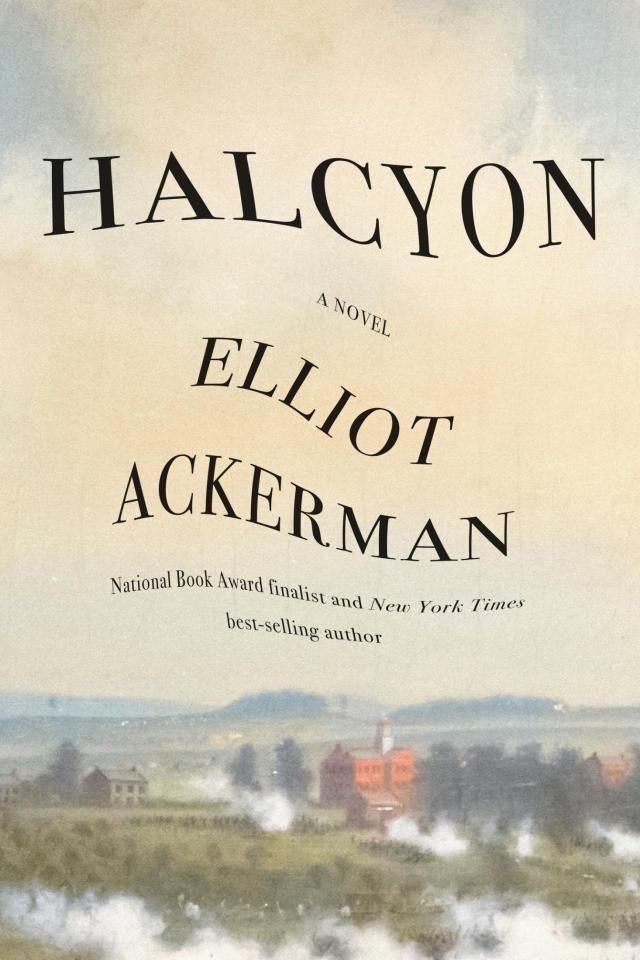
Cover image: Gettysburg, The First Day, 1863 (detail) by James Walker. IanDagnall / Alamy
Cover design by John Gall
DNA strand on title page by Mister Emil/Shutterstock, DNA model on part titles by Neokryuger/Shutterstock
ep_prh_6.1_143767943_c0_r1
Contents
Cover
Also by Elliot Ackerman
Title Page
Copyright
Dedication
Epigraph
Part One: Discovery
Part Two: Disease
Part Three: Petition
Part Four: Diagnosis
Part Five: Accusation
Part Six: Inquiry
Part Seven: Adjudication
Part Eight: Halcyon
Acknowledgments
A Note About the Author
_143767943_
In memory of
Edmund N. Carpenter II
1921–2008
“And what does it mean—dying?”
—Anton Chekhov,
The Cherry Orchard
ONE
DISCOVERY
News of the great discovery trickled out: resurrection, new life, had become a scientific possibility. The story ran below the fold in the Richmond Times-Dispatch on an unseasonably cold Sunday in April. The two narrow columns of text described how a team of government-backed geneticists had leveraged findings from the recently mapped human genome to regenerate cells in cryopreserved mice. Weeks and even months after death they were resurrecting these mice.
I had read about the “Lazarus mice” in a rented guest cottage nestled in the foothills of the snowcapped Blue Ridge. My reason for coming here was to escape, among other things, the relentless binges of breaking news that over the years had quietly subverted and replaced what was once known as “the national conversation.” The history department at Virginia College, where I taught (but have since left) had granted me a semester’s writing sabbatical along with a healthy allowance.
After finishing the Times-Dispatch that morning, I pitched it into the stone hearth at the cottage’s center where a half-burned back log still glowed; that is, I pitched all of it except the story on the Lazarus mice. I held on to that, choosing to save it for later that day, when my landlord, Robert Ableson, would come around for one of his early-evening visits. These visits proved a pleasant interlude after tedious, unproductive hours spent alone at my desk. I had rented the cottage from Ableson’s wife, Mary, who was more than twenty years his junior. This age difference, he admitted, had proven quite the scandal amidst the prudery of decades past—less so now. Mary was an old soul and Ableson was anything but, which caused her to joke that he was, in fact, her younger man. Handsome in a minor key, with clear bluish-gray eyes and carefully groomed hair still flecked with strands of reddish brown, his appearance belied his ninety years. His face was high-boned, his cheeks rosy and vital, his features distinct. He would have been a natural for a caricature except caricature freezes, and his face was a paradigm of fluid expression. He was possessed by a vigor that he insisted was the result of his daily walks. He called these his “constitutionals.”
It was after these constitutionals that Ableson would typically pay his visit, mixing us each one of his signature four-olive martinis, and we would settle in on the cottage’s lumpy furniture. Our talks would range in topic, animated by a collision of interests. My work: a study of postbellum attitudes on the Civil War. His life: service in the Second World War, a career as a prosecutor, and the behind-schedule and above-budget renovation of the property’s main house, a white brick neoclassical with a wraparound porch they called Halcyon, the name itself linked to the estate for as long as anyone could remember and conjuring a nostalgia for better days. We’d drain our glasses and the hours would pass while we exchanged our drink-inspired truths. Inevitably, the conversation would turn to the headlines, which was why that evening I had saved the story about the mice.
Before I get to Ableson’s reaction to those mice, the year itself, 2004, is a necessary digression; that year and the confluence of forces harnessed to create its zeitgeist are as much an actor in Ableson’s story as any one person. For those of us who lived through it, we can remember that it was a time when a frenzy pervaded our national psyche, with its liberal and conservative personalities conspiring against our collective sanity. From the political left and from the political right, America had learned over the years to binge on scandal (the Clinton conviction), on piety (September 11th), and on wrath (bin Laden’s body dragged from a cave in Tora Bora on Christmas Day). We had lost our ability to disaggregate our values from our rage. Opinion mattered. Accusation mattered. In recent memory had there been a greater epoch of either? Had there been a time when a single word (anonymous or otherwise) possessed greater potential to undo the old order on which we’d once relied? Destruction and creation were in the air, and so had there been a greater time of freedom? Didn’t our flawed society need to evolve? And, if we did evolve, would any of this associated destruction have been wrong? We didn’t know. Anything could happen. Nothing was sacred. All thinking became absolute. We congregated to the poles of leftward and rightward consciousness. We hollowed out the center of our political life, unraveling the braid of our societal obligations to one another only to awaken and realize with wonder that none of those obligations were—or ever had been—any stronger than a single strand of thread.
It was on those threads that Ableson’s life would come to depend, but that night the story of the mice was foremost in my mind. Had it appeared in the paper five or even ten years earlier—in a different time, which is to say a saner time—I wonder whether Ableson would have regarded it with such hostility. Once he’d finished reading, he handed me back the page with a flick of the wrist. “Utter nonsense,” he’d said as I took it from him. Did he think the report was a fabrication? “Martin,” he added, “I haven’t survived the better part of a century by believing every word put into print.” The doubt he’d introduced into something I had so readily believed left me feeling a tinge inferior. He went on, “You have to be careful with these scientists. They get their jollies playing God.”
I knew from our other conversations that Ableson wasn’t a particularly religious man. On a different night, after he’d lingered over too many martinis, that weighty subject had come up. I had confessed to Ableson that although I was born Jewish, I no longer practiced and wasn’t sure I even believed in God anymore. But I also knew it felt wrong to say God did not exist. “When people cease to believe in God,” he had answered, “they come to believe not in nothing but in anything.” For Ableson, God wasn’t a belief so much as a defense mechanism against other, more frightening forms of belief. Also, he thought he had little to lose by believing in God. If the other side of death was, truly, nothing, what did it matter if he believed. But if there was something on that other side, he had everything to gain. This was Ableson’s logic of heaven.
And now, gently, in service of the present conversation I reminded him of our previous one and its logic. “Is it so bad,” I asked, “if some scientists want to play God with mice? You’ve said it yourself: we’ve got nothing to lose and everything to gain.”
Ableson brooded by the fire. In the weeks since I’d met him, it was the first time he’d seemed uncomfortable furthering an argument. Eventually, he rose from his seat. He announced it was time for him to make his way back to Halcyon. The evening had turned overcast. The thermometer dipped below freezing. I offered Ableson a thicker coat for his return; however, he declined. He passed through my front door and made fresh tracks home through a curtain of steadily falling snow. As I watched him go his breath rose in a fine mist, crowning his head, a
* * *
—
Inches turned to feet as all night long the snow came down. I had finished off the shaker’s worth of martinis left behind by Ableson and this led to an obliterating sleep followed by an equally obliterating hangover the next morning, and when I finally awoke it was to a landscape transformed. The sky was a bracing chlorine blue, featureless and sublime. The snow was pristine, without a track—animal or human. Standing at my kitchen window, mug of coffee in hand, I felt as if I were witness to the very dawn of creation. This reverie, however, was interrupted by the realization that the single-lane dirt road connecting my guest cottage to Halcyon had vanished entirely.
I headed upstairs and sat at my desk, which was pushed to the gabled attic window. My vast, unfinished work was spread before me. My eyes ranged over it, and this only added to an intruding sense of isolation. Regrettably, this isolation had done little for my productivity. My project—a book, which that spring I was considering abandoning altogether—had to do with the Civil War and what the historian Shelby Foote termed “the great compromise,” a cultural reconciliation between North and South that followed those blood-soaked years. Before departing on sabbatical, my department chair had called me into her office to express “certain reservations,” as she’d put it. Foote’s interpretation of the war had fallen from favor, and she felt that the selected topic—particularly for a lapsed-Jewish divorcé of Ukrainian descent, like me—was problematic. I listened and, after giving her concerns the consideration they merited, replied: “How is my being a divorcé problematic?”
The idea of writing closer to my own experience had once occurred to me, but it’d proven a non-starter. As an undergraduate, when I’d asked my great-uncle Seymour the name of our family’s ancestral village in Ukraine, he’d said it was “Anatevka,” whistled a few bars of “If I Were a Rich Man,” and told me to focus on being American. So I’d chosen to study the Civil War and Foote had become my fixation. On C-SPAN Book TV, in a July 26, 1994, interview, he had said, “In the Civil War, there’s a great compromise as it’s called. It consists of Southerners admitting, freely, that it’s probably best that the Union wasn’t divided. And the North admits, rather freely, that the South fought bravely for a cause in which it believed. That is a great compromise and we live with that and it works for us.”
How, at times, I wished I could un-see that clip.
It had become the contentious seed from which my tangled work germinated. I had become obsessed with the role of compromise in the sustainment of American life, as well as our relatively recent departure from it as an American virtue. I had my theories on what contributed to our current plague of polarization: gerrymandering, the shifting media landscape, campaign finance laws; however, identifying the causes wasn’t enough, it would do nothing to ease our grim national mood, which I would have diagnosed as rage-ennui. I had once shared these views with Ableson, who through the wisdom of his many years identified a different source of America’s blight. “Sex,” he’d said, “the conflict between the male and the female, it is the conflict from which all others derive.” He was, of course, referring to our recently disgraced president. When I said as much, he made a little negative wave of his hand. His reference went far deeper than that, traveling backward well beyond Clinton or even my specialization, the Civil War. “The ancients fought about Helen of Troy. We fight about Monica Lewinsky. It’s all the same; it’s all sex.”
In my own work, I was, admittedly, searching for a theory as universal as what Ableson prescribed. However, no such theory had presented itself as I plowed through thousands of pages of nineteenth-century American history and increasingly found myself haunted by the ghost of Shelby Foote. If American life was in the past defined by the reconciliation of its divergent parts—“to form a more perfect Union” as the Constitution framed the endeavor—today American life had become defined by absolutes, and an absolute theory of this blight would, likely, forever elude me.
Below came a knock. Out my window, a string of footprints disturbed the otherwise unblemished snow and led to my front door, ending at the stoop. With my forehead pressed to the cold, mottled glass, I tried to see who stood there, but the angle wasn’t quite right. I could only make out a single set of diminutive shoulders no wider than the handles of a child’s scooter. Again, there was the insistent knocking. Whoever was at the door knew I was inside; and so I resigned myself to answering, taking the stairs carefully as my head continued to throb from last night’s martinis. “Be right there,” I called out; still the knocks came, a percussive torture. When I finally swung open the door, I was met by my landlady, Mary Ableson. “Mind if I come in?”
Whether I minded or not, Mrs. Ableson crossed the threshold, taking off her fur-lined parka and tossing it over the arm of a recliner as though she owned the place (which of course she did despite my rent being paid through August). As she entered—giving me a bit of her shoulder in the process—I once again noticed her height, how the top of her head ended exactly where the bottom of my chin began, as though we fit into each other in some way, like nesting dolls. At six-feet (five-foot-eleven-and-three-quarters, if we’re being stingy), my proportions are that of an unremarkable man of this new century. Mrs. Ableson, a tiny doll-like woman, was smaller but not in the normal way, and her miniaturized silhouette suggested another time, like those of mannikins in a museum’s display of costumes from one or even two centuries past. Her silver hair pulled back into a chignon retained a metallic luster. It was the hair of a woman determined to age gracefully and I doubt very much if she’d ever colored it in her life. She took off her leather gloves finger by finger, while rotating her neck in a panoramic arc as she examined the cottage. Her eyes, narrow and bright, pointed to the kitchen. I had left out the shaker and martini glasses from the night before. Her vision traced a direct line from the glasses to me. “Chilly in here, isn’t it?”
I nodded, crossed to the hearth at the center of the room, and began knotting pages of newspaper as I built another fire. Two sofas flanked the hearth with a coffee table between them. She sat on one and, having lit the fire, I settled down companionably on the sofa opposite hers. Observing her red-burnished cheeks and the continued heavy rise and fall of her chest plus a rapid succession of sniffles, I understood how she’d exhausted herself to reach me through the heavy snow. The subject she’d come to discuss must’ve been urgent.
“Was it much trouble walking out here?” I asked.
Mrs. Ableson stared vacantly at the purring fire, fingering a pendant around her neck. I could see it was a dime. But it wasn’t Roosevelt’s profile minted on the coin. This dime was of an older vintage, set on the pendant in what looked like platinum. Her eyes diverted from the fire to me, and they were wide and brown but not brown in a plain way; rather, in the way any collection of vibrant colors when blended together turns to brown. If you looked closely—as I was drawn to do—you could detect blues, greens, even hints of red in her gaze. “We need to discuss my husband,” she began. “I understand he’s been paying you visits.” She paused, employing a single beat of silence as an accusatory tool of rhetoric. She was, after all, the wife of a litigator. I could imagine a younger Mr. Ableson sequestered in his bedroom with Mary rehearsing his closing arguments, which she would edit down to the last gesture. With a similar precision, her gaze returned again to the martini glasses in the kitchen. “It’s not the drinking that worries me,” she said, her tone softening, from that of inquisitor to concerned wife. “What worries me is the newspaper story you showed him last night.”
“Newspaper story?” The day had yet to come into focus. I placed a fingertip to a sudden ache in my temple. Last night’s conversation with Ableson blurred with those of other nights.
“Yes, the story about the mice,” she said impatiently. “I’d like to see it.”






