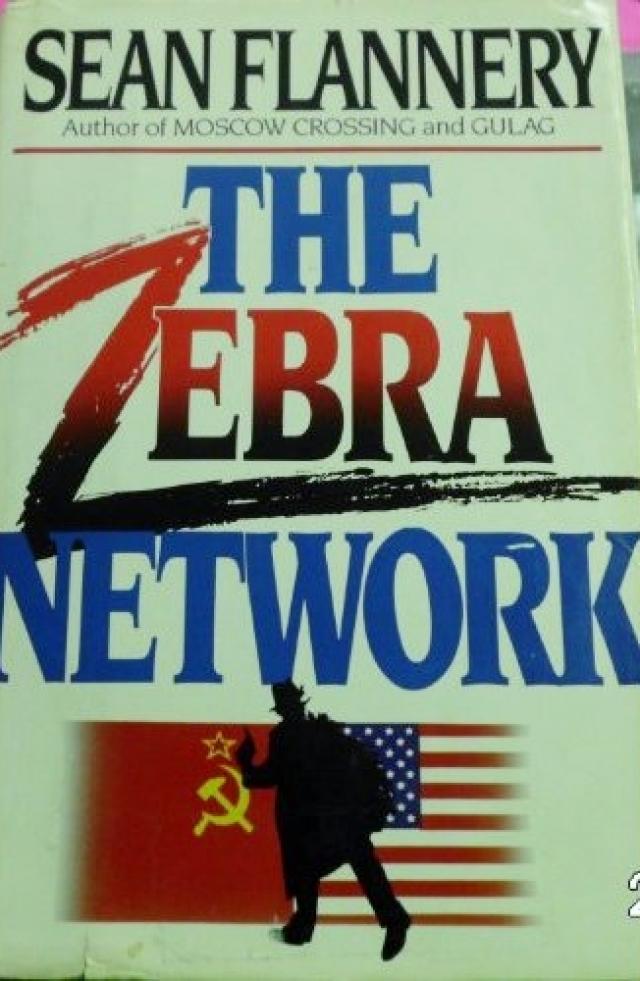
Zebra network, p.1
Zebra Network, page 1
part #1 of David MacAllister Series


Preface
WASHINGTON Accused Russian spy network kingpin James Franklin O’Haire, 42,
pleaded guilty Monday to charges of espionage and income tax evasion.
Along with his younger brother, U.S. Air Force Captain Liam Casey O’Haire, 37,
who pleaded guilty to the same charges last week, James O’Haire will likely be
sentenced to life imprisonment. Both brothers would be eligible for parole in 25 years.
The O’Haires were indicted in July after a two-year investigation by the U.S.
Justice Department, the Federal Bureau of Investigation and the U.S. Internal Revenue
Service. Investigators charge that James O’Haire headed the spy ring that included
seven other men and women besides his brother to hand over U.S. technical and
military secrets to the Soviet Union.
The other seven, who also pleaded guilty, will be sentenced in U.S. District Court
next month.
Investigators say the full extent of the damage the O’Haire spy ring inflicted on
U.S. interests may never be known. But they say it is extensive” and includes
information about the so-called Star Wars, Strategic Defense Initiative.
The last similar spy case in this country involved the Walker family in 1986.
Chapter 1
October had come early to Moscow. A few minutes after ten on an evening late
in the month, the air was January-crisp. Snow lay everywhere in big dirty piles. Moscow
was an eastern city; dark, brooding, mysterious. The onion domes of St. Basil’s on Red
Square seemed a natural counterpoint to the Kremlin’s Spassky Tower. A trollybus
rattled by. Two soldiers, drunk stupid on vodka, paused beneath a streetlight to pass
their bottle. An official Zil limousine raced along the right-hand lane, ignoring the
stoplights.
A tall, well-built American stepped from the doorway of a dumpy apartment
building on Yelizarovoy Street, just around the corner from the Embassy of Chad. He
hunched up his coat collar, looked both ways up the deserted street, and started on
foot to where he had parked his car two blocks away. He was just a little disgusted with
himself, and nervous. From time to time he looked over his shoulder as if he knew that
someone or something might be coming after him. At the end of the block he looked
back once more to the secondstory apartment window still lit with a dull yellow glow.
He was never going back. No reason for it. Look to Washington. Look to Moscow. Zebra
One, Zebra Two. They were Voronin’s words. Cryptic. Spoken in a self-pitying drunken
haze. Spittle had run down the cripple’s stubbled chin, his rheumy eyes hazed with
cataracts, his fists pounding on his useless legs.
This is the end then, the American thought turning once again and heading the
last blocks to his car. “When they start talking claptrap, boyo, it’s time to get yourself
free lest you get caught with your paws up some girl’s panties.” For six months he’d
worked Viktor Voronin, who had until eighteen months ago been an officer in the KGB.
A stupid, senseless automobile accident had crippled the man for life. The KGB had
retired him, of course, and he’d begun drinking on the same evening he got religion. No
more wars, he rambled. A world state in which everyone is equal. The perfect socialism.
But Voronin had been a gold seam. The mother lode. Some of what he had provided
them had been stunning, hadn’t it? Worth the risks. But tonight the clock had run
down. Voronin had finally slipped into a fantasy world in which he began to mix the
truth with his wild imaginings. He could no longer be considered reliable. Look to
Washington. Look to Moscow. What the hell was it supposed to mean? Zebra One,
Zebra Two.
He decided that his final report could wait until morning. It would go out with the
daily summaries to Langley by four in the afternoon, Moscow Civil Time. Operation Look
Back was finished, and he was glad of it. From start to finish it hadn’t been his sort of
project. “Listening to old bitter men vehemently denying their own countries, spewing
out their hate and vindictiveness is like digging through someone’s rotting garbage
looking for a decent meal,” he’d said.
At thirty-nine, David McAllister-Mac to his wife and friends did not like hiding in
closets, skulking around dark corners, opening other people’s mail, or listening to their
personal telephone conversations. An unlikely combination for a spy, he supposed, but
then he’d never known a spy who was-likely. He was a cautious man, which came from
his Scots’ heritage, though the nearest he’d ever come to his distant past was an
admitted enjoyment of bagpipe skirling and a pride in his grandfather, Stewart Alvin
McAllister, who’d come down to London from Edinburgh to straighten out the fledgling
British Secret Intelligence Service during the first world war. His father, who had
immigrated to the States in the early twenties, had joined the U.S. Army, had risen to
the rank of brigadier general, and had been one of the shakers and movers of the OSS
during the second world war, and the CIA afterward. The military, spying, and
tradecraft… all these things were in McAllister’s blood. Not babysitting old bitter men
with an axe to grind.
McAllister’s little Fiat was parked half up on the curb in the middle of a narrow,
deserted block. He took out his car keys as he reached it at the same moment a pair of
headlights appeared at the end of the street. He stopped and looked over his shoulder
as another pair of headlights appeared from behind. Both vehicles stopped.
They’d blocked off his only exits. McAllister forced himself to remain calm as he
stepped back and put his hand in his coat pocket, his fingers curling around the grip of
his Beretta 9 mm automatic. Carrying a gun around Moscow is madness, his station
chief had argued. “Until you need it,” he countered.
An amplified voice, speaking English, came from the end of the street. “Put your
hands up, please, in very plain sight.”
McAllister hesitated. Two men stepped out of the doorway of an apartment
building across the sidewalk from his Fiat. They were dressed in civilian clothes, but
they were armed with Kalashnikov assault rifles. In unison they drew back the ejector
slides.
Do not be foolish, Mr. McAllister. Do as you are told,” the amplified voice
instructed.
Two other men appeared on the opposite side of the street. There were no lights
in any of the apartments. The streetlights were out as well. He should have noticed.
Above, on the roofs on both sides of the street, he could make out the shadowy figures
of at least a dozen marksmen. They’d gone through a lot of trouble to get him. Because
of Voronin? He doubted it. They would have arrested him there. Slowly he took his
hand out of his pocket and then raised both hands over his head.
A short, very thin man dressed in a fur hat and bulky sheepskin coat came up
the street. He was dark, in a Georgian sort of a way, and intense, his motions quick,
birdlike. He stopped a couple of feet away.
“David Stewart McAllister,” he said, his English thick with a Russian accent. He
smiled. “At last. You are under arrest.”
“Charged with what?” McAllister asked, keeping calm. He’d be reported missing
within a couple of hours. Gloria would call the Embassy.
“Spying against the Soviet Union,” the little man said.
The morning came cold and dark gray as General Aleksandr Ilyich Borodin
stepped from the elevator on the fourth floor of KGB’s Lubyanka Headquarters and
charged down the corridor to his office, like a one-man freight train. He was a tall man,
by Russian standards, thick of neck and broad of chest, with a nearly bald head and
deep, penetrating eyes. Except for a certain overzealousness when it came to some of
his projects, it was rumored that he could have risen to director of the Komitet. For the
moment, it was said that wiser heads prevailed in the Kremlin which held him as
director of the First Chief Directorate’s Special Counterintelligence Service II, charged
with penetrating foreign secret intelligence operations.
On the way in from his dacha on the Istra River outside of town, the general had
run through the morning reports his driver had brought out. And now he was angry that
he had not been included in last night’s operation.
“Good morning, Comrade General,” his secretary said as Borodin charged
through his outer office and into his own private domain with its view of Dzerzhinsky
Square. “Get me General Suslev on the telephone,” Borodin bellowed, throwing off his
great coat and lighting a cigarette.
How coul d one hope to run an overseas operation without knowing what was
happening in one’s own back yard? All the years of work could easily be escaping like a
puff of smoke. Once it was away and dissipated no science in the world could
reconstruct it. Like acid rain it could even spread destroying everything in its path.
Coordination, was all he asked. Not so much. Even the CIA had its oversight committee
to make certain their people didn’t step on each other’s toes. It made sense, damnit. He
had argued until he was blue in the face, first with Andropov and then with that fool of
a successor.
He sat down, inhaling smoke deeply into his lungs, then closed his eyes. “With
care, Aleksandr,” he told himself. “It is time to move with care.”
His intercom buzzed. “It is General Suslev, sir,” his secretary said. Suslev was
head of the First Chief Directorate, charged with watching Americans in Russia.
Borodin picked up the telephone. “Nikolai, now what exactly was it you did last
night?”
“My job, Aleksandr Ilyich,” 5uslev said. “Arresting spies.”
“Who is he?”
“Come down and see for yourself, if you’re so anxious.”
General Borodin rode the elevator down to the basement and strode through the
broad stone-walled corridor to the interrogation center where he was immediately
passed through to Chief Interrogator Miroshnikov’s office. General Suslev was already
there. They were watching the American in the interrogation chamber through a
one-way glass. He’d obviously been here since they’d arrested him shortly after ten last
evening. His coat was off, his tie loose and at that moment he was seated in a
straight-backed chair, smoking a cigarette as he faced his two preliminary interrogators.
“Who is he?” General Borodin asked.
“David McAllister,” General Suslev said, looking up. The general, who had
changed his name from the Georgian Suslevili, was a small, intense man whom Borodin
hated with a passion. Suslev, however, would probably become the KGB’s director one
day. “He is a special assistant to the Ambassador.”
“CIA?”
“You’re particularly astute this morning, Aleksandr. Actually he’s deputy chief of
station.”
Borodin ignored the sarcasm. He stepped a little closer to the window so that he
could get a better look. McAllister seemed weary, his complexion pale in the harsh
white light reflecting sharply off the stark white tiles. He looked nervous, perhaps even
concerned, but he did not seem like the sort of man who would give in easily. It was
something about the American’s eyes that Borodin found fascinating. He could see in
them, even from this distance, a hint of power, of raw strength. It was a look he saw in
his own eyes each morning in the mirror. A look he admired. This one would be tough
to break.
“You have an interest in this case, Comrade General?” Chief Interrogator
Miroshnikov asked. He was a big, oily man, nearly as large as Borodin. But his eyes
were small and narrow and close set. They reminded his subordinates of pig eyes. No
one liked him. Even his wife, it was said, waited for the day her husband would be
struck down by a bus. But he was very good at his job, which was finding out things.”Is
there a possibility of turning him?” Borodin asked, masking the real reason for his
interest.
“I do not believe so,” Miroshnikov said wistfully. “Perhaps, given the time.
“You are on the wrong side of the ocean with this one, Aleksandr,” Suslev said.
“Your job is penetrating the CIA in Washington, not Moscow.”
“He will not remain in the Rodina forever, Nikolai,” Borodin said, gesturing
toward McAllister. “Not unless you mean to kill him.” He looked at the American again.
His eyes narrowed, as if he had thought of something else. “Where was he when you
picked him up?”
“Just off Lyalina Square,” Suslev answered. “What was he doing there at that
hour of the night? Meeting someone? Passing secrets?”
“We don’t know, yet. But he was armed,” Suslev said. “Perhaps we’ll find that
out this morning, Comrade General,” Miroshnikov said.
I Borodin looked at him, and then in at McAllister. He nodded.
With Miroshnikov across the table from you, anything was possible. He
shuddered inwardly. With Miroshnikov the coming days would not be very pleasant for
McAllister.
Colonel Petr Valentin Miroshnikov switched off the tape recorder and laid the
headphones on his desk. He sat back and stretched, temporarily relieving the pressure
on his lower spine. The day had not been entirely satisfactory. The American had
refused to give them anything, anything at all, and General Suslev had called every
hour wanting to know what progress had been made. Yet the interrogation was going
as it should. As he expected it would. There was a certain symmetry to these things.
First came the shock of arrest which led to a timidity between the prisoner and his
interviewers. It was up to the good interrogator to make the prisoner understand, as
soon as possible, that his very existence was no longer in his own hands. Someone else
controlled his destiny. From that moment on, the prisoner would become the
interrogator’s friend. They would become allies. Confidants in the end.
Miroshnikov looked at the tape recorder, then glanced into the empty
interrogation chamber: its stainless steel tables, its sturdy chairs, the instruments, the
white tiled floor and walls gleaming like an operating theater beneath strong overhead
lights, excited him. With McAllister the symmetry was there, but Miroshnikov knew that
the process would be long and drawn out and painful. From the first moment he’d laid
eyes on the American he’d instinctively sensed a strength in the man, well beyond the
men who had passed this way before. And for that Miroshnikov was grateful. Breaking a
man’s will, his spirit, was the real joy. If it was too easily accomplished, if it came too
quickly, there was little or no satisfaction. “The world is my will and my idea.” It was
bad 5chopenhauer philosophy, but one which Miroshnikov had embraced early as a
young exile growing up in Irkutsk in Siberia. He was an outsider. The foreigner in a land
of displaced persons, and he had to fight his way through school. His father had never
learned to fight or even cope and he had died out there, as had Miroshnikov’s mother.
But Petr had learned that the key to the domination of any man was in first
understanding his will and then making it yours.
The pitiful little Jews they sent to him who wanted to emigrate so badly to the
West, or the poor farmer boy turned soldier who was guilty of nothing more than
perhaps a moment’s indescretion were of no consequence. Boring actually. Just hauling
them into the Lubyanka was often all the impetus they needed to spill their guts. For a
few others, a few slihbas, Soviet political officers, who had become just a little too
enamored of life in the West, the challenge was somewhat greater, though intelligence
was not necessarily the mark of a man who could withstand an interrogation.
With this one, however, Miroshnikov sensed the biggest challenge of all.
McAllister was as intelligent as he was strong. Miroshnikov sensed in the American an