

Cafe berlin, p.1
Café Berlin, page 1


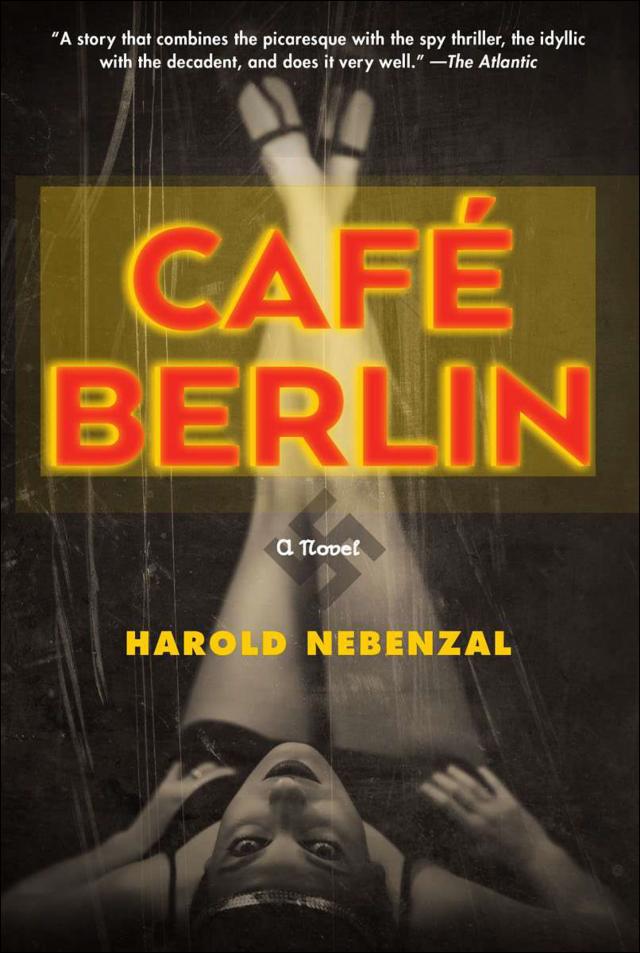
This edition first published in paperback in the United States in 2019 by
The Overlook Press, an imprint of ABRAMS
195 Broadway, 9th floor
New York, NY 10007
www.overlookpress.com
Abrams books are available at special discounts when purchased in quantity for premiums and promotions as well as fundraising or educational use. Special editions can also be created to specification. For details, contact specialsales@abramsbooks.com or the address above.
Copyright © 1992 by Harold Nebenzal
All Rights Reserved. No part of this publication may be reproduced or transmitted in any form or by any means, electronic or mechanical, including photocopy, recording, or any information storage and retrieval system now known or to be invented without permission in writing from the publisher, except by a reviewer who wishes to quote brief passages in connection with a review written for inclusion in a magazine, newspaper, or broadcast.
Library of Congress Cataloging-in-Publication Data
Nebenzal, Harold
Café Berlin / Harold Nebenzal
p. cm.
1. World War, 1939-1945 — Germany—Berlin—Fiction. 2. Berlin (Germany)—History—1918-1945—Fiction. I. Title
PS3564.E224C3 1992
813'.54—dc20
92-9079
CIP
Manufactured in the United States of America
ISBN 978-1-4683-1699-5
eISBN: 978-1-68335-713-1
I speak the Arabic of my native Damascus; Hebrew, the language of our faith; French, as taught by the Alliance Israélite; Ladino, the ancient Spanish of the Sephardim; sufficient Italian; the Russian I have learned from my kitchen help; German, the language of my seemingly last way station; and English, the language of those, other than my parents, whom I have served faithfully and well.
Other than invoices, bills of lading, and an occasional postcard, I have never written much in any of them. I shall use the language of those in whom lies the hope and salvation of the world. As we say, “Con el pie derecho y el nombre del Dio” — “With the right foot forward and with the name of God” — I commence: in English.
DANIEL SAPORTA, SON OF EZRA
Berlin, November 14, 1943
November 14, 1943
I have been in hiding since the sixteenth of December, 1941—one month short of two years. Why I waited this long before starting to write, I cannot say. I suppose it took this long for the realization to sink in that my enforced residence would not be terminated by some fortuitous event. I am older, sadder, wiser, and have learned to eat the bitter bread of patience. Thus these memoirs, whose uncomfortable beginnings you witness here.
Lohmann comes almost every day but he hasn’t been here since the tenth, which means I haven’t eaten in three days and I feel quite light-headed. What could have kept him? I miss him and I miss what I call the feeding ritual. It has become important to me, as have my recently resurrected morning and evening prayers: anything to give some meaning to the monotony of my days. I have also tried push-ups, an exercise in vanity, to keep the body in shape. The rewards were headaches, accompanied, strangely, by a toothache I am not anxious to reawaken.
Lohmann’s entrance never varies. First, I hear footsteps on the wooden attic floorboards and the shifting of an armoire, followed by his entrance into my refuge. There is a truncated lifting of his hat, a dry, brisk handshake with a stiff bow, and the appearance of a package from the depths of his overcoat pocket. He places the package on my little table. It is of wrinkled brown paper, firmly secured by a length of twine.
Lohmann then carefully unties the string, wraps it around his index and middle finger, and places the loop on the table. Next comes the unfolding of the butcher paper—it has been the same for weeks—which he smooths free of folds and wrinkles. Folded into a tidy square, it joins the twine on the tabletop. He repeats the process with the sheet of waxed paper that enfolds the reason for this exercise: a piece of gray rye bread with a white coating of pork fat, or, perhaps a Schrippe, the crusty bread roll of the Berliners, with a piece of Harzer cheese or a thick slice of onion in its middle. At the beginning there were cutlets and pieces of stew meat, but food is getting scarce and I am grateful for every potato, for every winter apple, that Lohmann brings.
He does something else for me: he removes my wastes. Unquestioningly, he carries the galvanized bucket to the communal toilet on the fourth-floor landing and, after emptying it, returns it to me. He is cautious and has so far not been observed. It is not a problem now, during the icy winter months; I keep the bucket outside, well concealed by the dormer window. Whether I shall still need the bucket when the weather turns warm depends on Lohmann. Actually, my very life depends on him. Should he be killed or injured during the air raids, should he be taken ill, should he be denounced to the authorities, it would signal an end to the twists and turns, the small glories and the greater shames of an existence that began in Damascus thirty-two years ago.
November 15, 1943
During the night, my recurrent dream of Damascus. We are sitting on the balcony of my father’s house: my father, my mother, my brother, Victor, my sisters Fortuna and Sultana. The air is heavy with the scent of jasmine and mimosa. The maid, Fawzia, has been sent to a neighborhood restaurant; she has returned with a platter piled high with grilled pigeons. They are pungent with lemon juice and flat leaf parsley. My father, fez on his head, says the blessing: “Blessed art thou, Lord, King of the universe, through whose Word all things are called into being.” We devour the pigeons, a mountain of them. The gramophone plays in the living room: “Zourouni kol sana marra’—Call on Me Once a Year—by the Egyptian composer Sayyid Darwish. This song of love and pain is my father’s favorite. The ululations, the beat of the derbakke, are physical; the repetition narcotic. The soars, the gasps, the plunges of Arabic song are beyond those of the West. They touch our soul, our genitals, with rose-scented fingers. We are glassy-eyed with sated torpor. My father sips his Turkish coffee. His tiny cup releases the sweet bitterness of the grounds, laced with the essence of orange blossoms; the perfume blends with the heady blooms weighing down our balcony. The thought remains unspoken: that this may last for all eternity, Inch’allah.
November 18, 1943
Today Lohmann’s overcoat pocket turned out to be a veritable cornucopia of delicacies: slices of meat loaf—mostly bread, of course, with precious little meat, held together with fat but delicious nevertheless. There was a jar of cabbage and turnip soup and half a loaf of bread, a length of hard sausage, and some rather stiff fried doughnuts.
Lohmann explained that while crossing the Nollendorf Platz he had run into a friend, a waiter by profession, who had been in Lohmann’s sapper company during the First World War. They had served together in the trenches of the Marne in 1916. He now had a permanent billet with the Winterhilfswerk, a welfare organization set up by the Nazi Party to assist the needy and, principally, those bombed out of their homes by Allied bombing raids. The Winterhilfswerk distributes blankets and warm clothing and doles out warm meals from mobile kitchens known as “goulash cannons.” The ex soldier-cum-waiter works in the commissary branch, which allots comestibles to the vast network of the Winterhilfswerk. This regimental mate had invited Lohmann to grab while the grabbing was good. Lohmann also brought a supply of old newspapers. Not only are they my lifeline to the world but, more importantly, they keep me warm in my Spartan attic. Newspapers, when wrapped around the arms and legs and about the torso, beneath shirt and trousers, preserve body heat to a remarkable degree. I also sleep between layers of newspapers: a bottom layer over the icy cushions of the horsehide couch, a top layer secured by my overcoat and ragged quilt. I owe my very breath to Lohmann, and in my mind, at least, I have never done anything for him commensurate with the kindness he lavishes on me at great personal risk.
I met Lohmann in 1929, shortly after Herr Landau had thrown me out of his house. Landau had accused me of seducing the children’s nursemaid, who was showing signs of morning sickness. It was a black-hearted lie. It was I who had been seduced, not by the nursemaid but by Frau Landau. The old saw holds true: the husband is always the last to know.
Thus, at age eighteen, I found myself in the streets of Berlin and unwilling to return to Damascus, where my father’s fortunes had begun to sour. The French had dethroned King Faisal and occupied Syria, thus awakening nationalist fervor in the Arab and Druze masses. This in turn created a sense of insecurity among the Jews, Armenians, and Maronite Christians, who now cast a nervous eye toward potentially more hospitable lands.
I had no great incentive to return to the limiting life of the Levantine middle class, but in the fall of 1929, things did not look promising in Germany either. On the twenty-ninth of October the stock market of New York crashed. It plunged the United States into depression and sent such shock waves throughout the world that here in Germany the painful recovery from the inflation, which had raged between 1922 and 1925, ground to a halt. During the inflation, the little nest eggs of widows, war veterans, and retired civil servants had evaporated; their pitiful mark notes stuffed into mattresses or into sugar bowls on kitchen shelves had become as the old newspapers that scudded in the frozen gutters. The inflation did not spare the substantial savings of the middle class either, but it took the great crash of 1929, with its ensuing depression, to devastate the well-to-do, the businessmen and entrepreneurs: the very class of people to whom the others looked for jobs and security. Unemployment, and with it membership in the Nazi Party, soa
Before being cashiered from their household, I had often accompanied the Landaus on their evening outings, to the theater and to restaurants. I was aware that although the German masses suffered cruelly, plenty of people were doing well during this period. There were the businessmen who had some sophistication in their dealings, those who had foreign accounts, those who had saved foreign currency, those who bought when others sold, and vice versa. There was also a class of profiteers: Germans who had holdings abroad; foreigners from every continent who had come, during the inflation, to pick up the pieces. And there were the purveyors of cocaine, heroin, cannabis; also the pimps, active in both import and export. They fetched country girls from the impoverished farms of Pomerania and Silesia with offers of work as waitresses and salesgirls. Once in Berlin, the young women were drugged, debased, and debauched until they were tractable and started to turn a profit on the sidewalks or in the many brothels that dotted the city. True blondes who showed promise in their newly acquired trade were shipped off to Cairo and Buenos Aires, to Port Said and Caracas, where an appreciative clientele awaited them.
To accommodate and anticipate the wishes of this free-spending class, the city offered an incredible variety of restaurants: provincial German, Austro-Hungarian, Polish, Czech, Russian, Chinese, and strictly kasher. All this was available in infinite gradations, from the luxury of the Adlon, the Bristol, and Horcher’s to comfortable lunchrooms and beer-and-sausage emporiums. There were bars for draymen and coal and potato dealers, for homosexuals, lesbians, and every other persuasion. There were nightclubs with telephones on each table, from which one could request a fox-trot or proposition guests at other tables. There were clubs with female impersonators, clubs featuring political satire, and clubs where people fornicated on the stage, in which pastime the public was asked to join. And did.
I must stop. My hand hurts. I have difficulty extending my fingers. Is it arthritis, or is it the damnable cold?
November 19, 1943
I learned about nightclubs from my cousin Eli. Eli is four years older than I and worked in my father’s warehouse. Although he was a dutiful son and supported his widowed mother, he spent most of his money in seedy nightclubs and on the prostitutes behind the Hejaz railroad station.
My mother would say, “Eli est un voyou”—Eli is a scoundrel.
My father defended him. “Eli is a good boy. He has a feel for the business. He can look at peppers and tell you where they were grown within a hundred dunams. He’s only seventeen, and right now he’s letting his little head rule his big head.”
“Ezra, I must ask you not to be vulgar in front of the children—or in front of me, for that matter. You know I cannot abide it.” My mother said this grandly, in the manner of the French convent school she had attended.
My mother’s protests notwithstanding, I was attracted to Eli and his evil ways. Eli was already a man of the world. He slathered and combed his hair with Bakerfix until his coal-black mane shone like a raven’s wing. Bakerfix was a French hair cream Eli bought in the souk. It was named after the American Negress Josephine Baker, who was the toast of Paris. My sisters knew her hit song, “J’ai deux amours, mon pays et Paris,” by heart. La Baker’s picture was on the tube of hairdressing, emphasizing the mannish, patent-leather look of her coiffure. Eli also affected gray suede shoes trimmed with patent leather. He assured me the look he cultivated was totally Parisian.
What I admired most in Eli was that he already commanded the attention, if not the respect, of grown-ups. The coffee vendors balancing their brass trays, the shoeshine men banging their brushes against their boxes, never failed to greet him in the street. “Marhaba yah Eli!” they would shout. Eli would give them a hand salute, in the fashion of Arab politicians, or share his cigarettes with them, or the purple Violettes de Parme, the crystallized candy blossoms, which he carried in his vest pocket. I was also impressed by how the doorman of the Semiramis nightclub greeted Eli. The doorman was a pockmarked Kurd, whose fierce countenance was embellished by a huge mustache and a blind milk-blue eyeball. The good eye, merciless in its glare, became merry when he recognized Eli. The doorman proffered the traditional “Ahlan we sahlan”—You are welcome—upon seeing us and, after a whispered conference with Eli, ushered us into the club itself. The Semiramis was a second-class establishment at best: dark, yet gaudy, illuminated by multicolored light bulbs—the sort used in the West for Christmas decoration. Hard chairs and small tables crowded a barely elevated stage from which the management presented its nightly entertainment. This never varied and consisted of the house orchestra: oud, kanoon, derbakke, and violin. They backed the belly dancers, who were spelled by singers of either sex. These artistes all reappeared after several months’ interval, completing the circuit that took them to Homs, Aleppo, Latakia, and Basra or, as the result of a fortunate booking, on an occasional foray into Beirut or even Baghdad.
This particular evening was a turning point in my life. There is no question in my mind that it was this evening, at the Semiramis, which led me to buy the Kaukasus Klub, in Berlin, twenty-four hours after having left the Landau household.
We were seated in a darkened loge where, I suppose because of our tender years, we could watch the entertainment unobserved by the customers.
The Kurd brought us a narghile, a water pipe, which contained hashish mixed with leaf tobacco. We puffed, I for the first time, and soon I felt a rush of heat to my extremities, followed by the sense of detached amusement Eli had so often described to me. By the time the first belly dancer had taken to the floor, the Semiramis had filled up quite respectably. Most of the customers were small businessmen. I recognized Abou Issa, one of our customers, a spice dealer in the Attarine market. There were lesser government functionaries, two Armenian goldsmiths with a customer, some pomaded procurers, and a tableful of Bedouins from the Hejaz, judging by their dark complexions and the manner in which they wore the kaffiyehs. They alone among the clientele abstained from drinking the rotgut arak. This, along with pistachios and olives, was the champagne and caviar of a Levantine boite.
According to cousin Eli the first dancer was Jamila, twenty-six years old, from Egypt. She had been the mistress of a banker in Beirut. Eli shared this knowledge with me as a European would speak of a well-known soccer player. I was already under Jamila’s sway. How could a boy of fourteen react otherwise to a graphic presentation of his sexual fantasies?
Interminably, Jamila twirled, lifting and lowering the aquamarine veil with which she covered her breasts and abdomen. Suddenly the drum beat picked up and became an unabashedly coital rhythm, which the cognoscenti greeted with a ripple of applause. Jamila dropped her veil, revealing full breasts encased in an embroidered brassiere. Her smooth, white, slightly protruding belly was barely held in check by a coin-decorated belt, which snaked down to cover her pubis, her lokoum or “Turkish delight,” as Eli preferred to call it. Jamila undulated, shook her breasts, stood still, made them quiver, resumed her dance, and then slowly started to thrust and withdraw her pelvis, as if it were impaled on the zoub of some invisible lover. By this time I was totally tumescent. Eli, who could read me like a book, nudged me with his elbow, grabbed his crotch, and rolled his eyes wildly. He had seen me as I saw myself—a dog in heat, the red organ out of its sheath—and I hated him for it. But Jamila was not through. She now stood on the corner of the stage facing our loge, and her odor of sweat and patchouli came to us. She stood quite still. Only the muscles in her belly started an imperceptible ripple, which she maintained to the beat of the drum. I could see drops of sweat snake down between her breasts, joining the rivulet that coursed to her navel and then ran down into the waistband of her belt. The ripples became waves. She undulated her belly as if it had a life of its own. She kept this up as the beat increased. Then, with a cry, she dropped to the floor, arched her back, spread her thighs, and rolled over, head hidden in the crook of her arm, as if in a gesture of shame and humiliation. It was a touch the audience appreciated. The applause was tumultuous. I was brought out of my reverie by Eli. “Yah, habibi!” he said. “That Jamila has some muscles in her kous! She could slice bananas with it.”






