Baf 58 imaginary world.., p.1
BAF 58 - Imaginary Worlds, page 1
part #58 of Ballantine Adult Fantasy Series


13-07-2024
Like Lin Carter’s other splendid “look behind” volumes (on J. R. R. Tolkien and H. P. Love-craft), this book examines the background and creation of the imaginary worlds of some of the most famous writers to appear in the field of Adult Fantasy, of which Ballantine Books is the leading publisher.
IMAGINARY WORLDS is a book about fantasy, about the men who write it, and how it is written. It is a joyful excursion by a man who himself loves fantasy, into the origins and the magicks of such writers as Duns any, Eddison, Cabell: it examines the rise of fantasy in the American pulp magazines and delights in the sturdy health of “sword and sorcery”: it looks with pleasure on the works of some modern masters and knowledgeably explores the techniques of world-making.
It is, in short, a happy exploration of worlds, and men, and writers, and writings, by an author whose enthusiasm for his subject is boundless—and is thus a joyous guide for fantasy lovers everywhere.
For Ballantine Books,
Lin Carter has written:
Imaginary Worlds: The Art of Fantasy
Lovecraft: A Look Behind the “Cthulhu Mythos”
Tolkien: A Look Behind “The Lord of the Rings”
and has edited these anthologies and collections:
At the Edge of the World I Beyond the Fields We Know I Discoveries in Fantasy I The Doom That Came to Samath I Dragons, Elves, and Heroes I The Dream-Quest of Unknown Kadath I Evenor I Golden Cities, Far I Great Short Novels of Adult Fantasy I I Great Short Novels of Adult Fantasy II I Hyperborea I New Worlds For Old I The Spawn of Cthulhu I Xiccarph I The Young Magicians I Zothique
IMAGINARY
WORLDS
The Art of Fantasy
Lin Carter
BALLANTTNE BOOKS • NEW YORK
Copyright © 1973 by Lin Carter
All rights reserved.
SBN 345-03309-4-125
First Printing: June, 1973
Printed in the United States of America
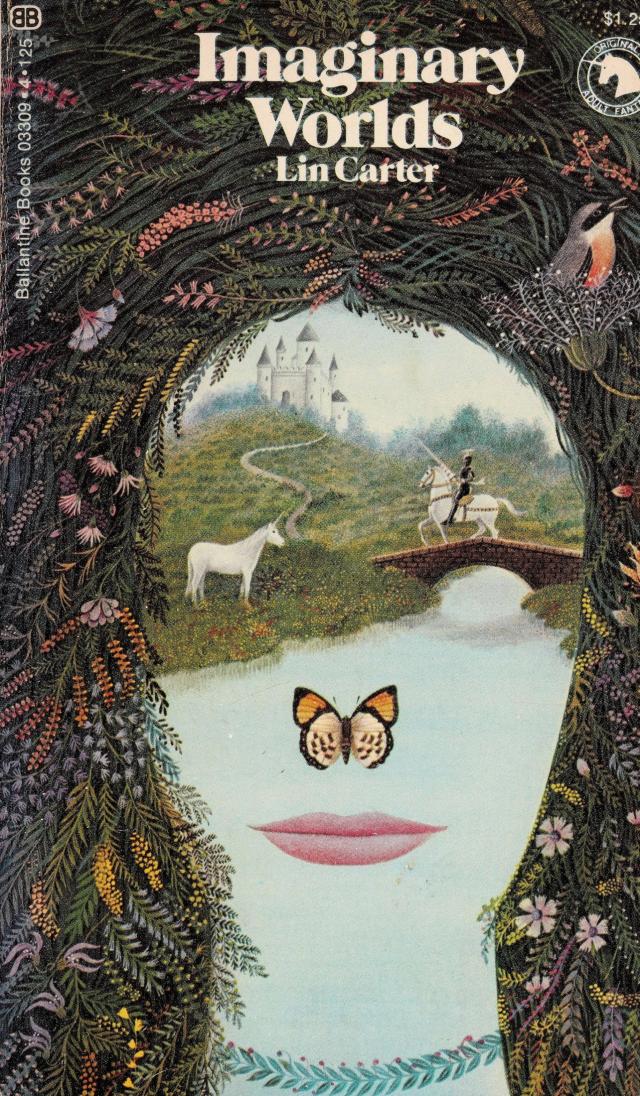
Cover art by Gervasio Gallardo
BALLANTINE BOOKS, INC.
201 E. 50th Street, New York, N. Y. 10022
Dedication
I enjoy dedicating my books to my friends and fellow-writers, and I usually strive to match the book to the man. Since this book is a history of fantasy, it seems to me fitting that I dedicate it to the fantasy writers of tomorrow, to those men and women not yet born, whom I shall never know, whose books I shall not live to read, but whose dreams I have shared and whose visions would not be strange or alien to me.
—Lin Carter
Contents
Introduction ~ The Empire of Imagination
1 - From Uruk to Utterbol:
2 - The World’s Edge, and Beyond:
3 - Lost Cities, Forgotten Ages:
4 - The Mathematics of Magic:
5 - From The Night Land to Narnia
6 - The Inklings Produce a Classic:
7 - Post-Howardian Heroica:
8 - The Young Magicians:
9 - Of World-Making
10 - A Local Habitation and a Hame:
11 - The Tricks of the Trade:
Notes
Bibliography I: General References
Bibliography II: The Adult Fantasy Series
Introduction
The Empire of Imagination
Each change of many-colour’d life he drew,
Exhausted worlds, and then imagin’d new.
—Samuel Johnson: “Prologue…,”1
Why do we who love fantasy read it with such delight and gusto, returning to it again and again over the years as to a source of entertainment that is inexhaustible?
Our mania—and it is virtually that—is shared by few. Most people, an overwhelming majority of the populace in fact, read nothing at all beyond their newspapers, a few glossy magazines, and an occasional fat best seller. Even those who do read books seldom pursue one genre with the devotion and intensity of our passion. I cannot believe that devotees of the whodunit, the western, or the “ladies’ Gothic romance” read and collect books in their chosen province of literature as assiduously as do we.
Frankly, I have no answer to this question; nor am I even going to attempt to answer it. In fact, I can hardly understand the sort of mind that would require an answer to such a question. We read fantasy because we love it; we love it because we find it a source of the marvel and mystery and wonder and joy that we can find nowhere else.
We return again and again to our favorite writers, (and to individual books,) because the magic of their imagination is ever fresh and new and exciting to us. Some of us may prefer Lord Dunsany or James Branch Cabell, T. H. White or J. R. R. Tolkien; others may like H. P. Lovecraft or A. Merritt, Robert E. Howard or Clark Ashton Smith, C. S. Lewis or Edgar Rice Burroughs. But never mind slight differences in taste; we understand each other: our common enthusiasm is—fantasy. Many of us do not even differentiate between adult and juvenile fantasy—indeed, a very thin line divides the two.
Are we incurable romantics—idle dreamers, bored by the everyday world around us—seeking escape from the sordid realities we find repellent? Or are we men and women whose esthetic or intellectual development was somehow arrested in childhood, so that we still yearn for the stuff of dreams, the sort of thing we found in fairy-tales and children’s books when we were young? The charge of “escapist reading” is most often leveled against fantasy and science fiction, by those who have forgotten or overlooked the simple fact that virtually all reading—all music and poetry and art and drama and philosophy, for that matter—is a temporary escape from what is around us.
Why do I read fantasy? I really don’t know; I really don’t care. All I know is that something within me wakes and thrills and responds to phrases like “the splendid city of Celephais, in the Valley of Ooth-Nargai, beyond the Tanarian Hills,” where galleys “sail up the river Oukranos past the gilded spires of Thran,” and “elephant caravans tramp through perfumed jungles in Kled,” where “forgotten palaces with veined ivory columns sleep lovely and unbroken under the moon.”2
Such phrases, such sequences of gorgeous imagery, touch something that is within most of us, really. I believe that a hunger for the fabulous is common to the human condition. To be a human being is to possess the capacity to dream; and few of us are so degraded or brutalized that we have no thirst for miracles. But try the experiment yourself—does something stir within you when you read of “Ilek-Vad, that fabulous town of turrets atop the hollow cliffs of glass that overlook the twilight sea wherein the finned and bearded Gnorri build their singular labyrinths,” or of “Zamora, with its dark-haired women and towers of spider-haunted mystery,” or “Stygia, with its shadow-guarded tombs”?3
If so, then you already understand what I am talking about; if not, then this book is probably not for you. But whatever it is that sings within me to such imagery, I am happy that it is there.
This is a book about fantasy, about the men who write it and how it is written. Oddly enough, no one has ever written a book on fantasy before. The neighboring provinces of imaginative literature have not suffered the same neglect, for excellent surveys of science fiction and supernatural literature continue to appear. It is fantasy alone—the source from which both sister genres originally sprang—which has so curiously and so persistently been ignored by the historians of literature.
This is not to say that books have not been written about the more important authors of fantasy. There are critical studies of Cabell and Tolkien, bibliographies of Merritt and Smith, formal biographies of Burroughs and White, informal memoirs of Duns any and Love-craft. (For a listing of such, see Bibliography I: General References, at the end of this book.) But these books do not cover sufficient ground: of necessity, such works limit their scope to the achievements and the career of one writer—and where they do touch upon the genre to which the writer contributed, it is generally to discuss only those authors who influenced him, and those whom he in turn influenced. What is needed, obviously, is a book that focuses not merely upon this or that writer in the genre, but upon the genre itself: the tradition from which evolved writers such as those I have already mentioned and to which they contributed so much.
This neglect of what is, after all, a major province of narrative literature seems to me inexplicable. I can only assume that the historians of literature have neglected fantasy because it does not seem “serious” enough to be worthy of study by the academic mind. When serious scholars think of fantasy they think of mythology, of fairy tales—the sort of thing long since relegated to the nursery. Fantasy, they seem to believe, does not come to grips with the human condition, as does the modern psychological novel; it very often tends to “merely” entertain, rather than probing into injustice as does the novel of social realism.
Of course, as you and I know, this is nonsense. Fantasy is a very large and rich and important province of fiction, and a very ancient one. If I wished, I could cite a considerable body of evidence which suggests that fantasy is no less than the original form of narrative literature itself. I will go into this theme a bit further on, so I will not pause to develop it here. But it is certain that those academicians who neglect fantastic literature to analyze the more “serious” schools of fiction, such as the novel of realism—those who win their reputations as serious scholars by learned dissertations on the sources of Hemingway or Dos Passos—are passing over a distinguished and venerable province of letters for a comparatively recent, and perhaps transient, innovation.
& nbsp; After all, the realist school looks to Gustave Flaubert as its first master, and to Madame Bovary as the first successful attempt at a scrupulously accurate portraiture of everyday life. And Madame Bovary was only published in 1856. Thus, the novel of social realism is a very modern development; but then, so is the novel itself, which only emerged as a distinctly individual art form about two hundred years ago, with Daniel Defoe, Samuel Richardson, and Henry Fielding. It amuses me to recall that the very earliest beginnings of the European novel—with Rabelais’ Gargantua and Pantagruel (1535), say, or with Cervantes’ Don Quixote (1605, 1615)—were a revolt against fantasy, which then dominated literature in the form of the romance. Both Gargantua and the great Quixote are literary lampoons, caricaturing the ridiculous excesses of the fantastic extravaganzas written in imitation of Amadis of Gaul and Palmerin of England and the like, which are prime examples of the heroic fantasy. Yes, fantasy was going strong centuries before this emergence of the novel, and fantasy was the theme of the old prose romances which the novel rose to replace, even as it was, still earlier, with the literature of epic, saga and myth which flourished before the birth of romance.
Considering the antiquity of the genre, its neglect by the scholars and literary historians becomes all the more lamentable. It is a neglect which I hope, however modestly, to correct.
Now—what exactly do I mean by “fantasy”? Webster defines it as “imagination or fancy; a product of imagination, specifically, an image; mood, especially a whimsical or capricious one.” Well, so much for the boys who write the dictionaries! We shall let them remain in blissful ignorance of an entire genre of fiction.
Aficionados will agree that the term “fantasy” covers a wide variety of different kinds of stories. Careless reviewers of books and movies use the term so loosely as to include everything from Dracula to 2001: A Space Odyssey, and oddly enough, they are not too far off. In the broadest possible sense, fantasy is any kind of fiction that is fantastic, that is, fiction that is not realistic. Since neither ghost stories nor space operas are true to everyday life, they come under the term “fantasy.”
What actually happened is that, way back when, both the tale of supernatural horror and what then passed as science fiction were part of the broad field of fantastic literature. Both, however, managed to isolate and concentrate their individual natures and became polarized, breaking away from the central fantasy tradition and evolving into sub-genre all their own. The supernatural tale did this quite early, about 1765 or so, with the publication of Horace Walpole’s The Castle of Otranto, which founded and was the first great success of the school of the Gothic novel. As for science fiction, it began to emerge as a separate genre of fantastic literature about a century ago—say, sometime after 1862, the year in which Jules Verne made his first great popular success with a novel called Cinq semaines en ballon (Five Weeks in a Balloon, that is). This novel was the first of a genre originally called, d, la Verne, voyages imaginaires—a genre which became known as “the scientific romance” during the floruit of H. G. Wells, and which evolved with time into what Hugo Gemsback called “science fiction.”4
But what I mean by the word “fantasy” is a narrative of marvels that belong to neither the scientific nor the supernatural. The essence of this sort of story can be summed up in one word: magic. A fantasy is a book or story, then, in which magic really works—not a fairytale, not a story written for children, like Peter Pan or The Wizard of Oz, but a work of fiction written for adults—a story which challenges the mind, which sets it working.
Now there are all kinds of stories in this broad category. Before the Victorian romancer William Morris entered the picture, there were oodles of books written that might be described as fantasy—novels that were mythological, or Arthurian, or theosophical, or Rosicrucian, or occult, or alchemical, or mystical, or whatever. To widen our discussion to include all of these varieties would lengthen this book into several volumes, so let us narrow our scope a bit.
In the real world in which we live, magic does not work. A fantasy, by the above definition, is a story set in a milieu that includes magic as an integral part of the natural world. Since we have yet to find a place among the laws of physics for magic powers, such tales imply—in fact, such tales actually require—the construction of an invented milieu. To compose a fantasy, an author must construct a literary universe in which magic works; hence the title of this study, Imaginary Worlds—for that is precisely what fantasy is all about
The invented milieu, of course, can be used for things other than fantasy. The Prisoner of Zenda, although set in an imaginary country called “Graustark,” is not a fantasy (although it could be, if there were any Graustarkian magicians in the story). The difference lies in the fact that The Prisoner of Zenda is not a narrative of marvels but an adventure story. There are many similar examples in literature of the invented milieu used for purposes other than fantasy, such as Gilbert and Sullivan’s imaginary country “Barataria” in The Gondoliers, and William Faulkner’s “Yoknapatawpha County” in Mississippi, which was introduced in the novel Sartoris (1929), but I trust that you understand the difference between such usages and fantasy itself—magic works neither in Faulkner’s invented Mississippi county, nor in the imaginary setting of the comic opera.
So we focus upon one particular kind of fantasy, which might be called the mainstream, the central tradition, of fantasy as a whole. Some critics prefer the term “pure fantasy” or “heroic fantasy” to my term, “the imaginary world” story, but we are all talking about the same thing: the story laid in settings completely made up by the author, whether such settings consist of a single country or an entire world, or even an imaginary period of the remote past or the distant future.
To further complicate this problem of defining our terms, there are those stories set in imaginary settings not invented by their author, but borrowed by him or her from another source—T. H. White, for example, who lifted the milieu for The Once and Future King from Arthurian literature; or Fletcher Pratt and L. Sprague de Camp, who borrowed the scenery of The Castle of Iron from Ariosto; or Evangeline Walton, who set The Island of the Mighty in the world of Welsh mythology. Many another national mythos has been ransacked by fantasy writers, including the Irish, Norse, Finnish, and Roman; even American Indian folklore has not gone untouched.’
We do not generally include these stories in the central fantasy tradition, although of course they border closely upon it. The deciding factor is, I suppose, tradition: William Morris invented the imaginary-world novel, and the central tradition derives from his pioneering romances, which are laid in Medieval world-scapes completely his own invention, although quite similar to those in Malory and in Sintram, generally considered to be his sources. Stories that are firmly part of the tradition Morris founded are stories set in worldscapes invented by their author, just as Morris did it. That may sound mighty arbitrary, but there it is. Every literary genre is an arbitrary system of classification which can be debated endlessly (is Macbeth a play or a poem? Is Hamlet a ghost-story or a murder-mystery? Is A Midsummer Night’s Dream a comedy or a fairy-tale?). You have to establish your criteria first, before you can discuss anything in depth.
So, those of us who are interested in the imaginary-world tale have set up our system of definition and hew to it, letting the quibbles fall where they may. And while stories such as those mentioned above are still imaginary-world fictions of a kind—in a certain limited sense—they are not pure examples of the genre. That is, their settings were not completely invented by their authors, even though these settings are still largely imaginary and have no valid claim to genuine historical existence. No Arthur Pendragon, tutored by Merlyn, armed with Excalibur, ever kinged it in many-spired Camelot while his knights rode around the countryside hunting for the Holy Grail; neither did any such sorcerer as Atlantes ever stable a hippogriff in a magic iron castle atop the Pyrenees; and while the high gods of Wales might have had their origin in a bunch of prehistoric chieftains, I doubt if they were the sort of giants and magicians the Mabinogion describes.