The withdrawal, p.1
The Withdrawal, page 1


ALSO BY NOAM CHOMSKY
The Cold War and the University
Understanding Power
American Power and the New Mandarins
Towards a New Cold War
Problems of Knowledge and Freedom
Objectivity and Liberal Scholarship
For Reasons of State
The Chomsky–Foucault Debate
On Language
The Essential Chomsky
On Anarchism
The Responsibility of Intellectuals
ALSO BY VIJAY PRASHAD
The Karma of Brown Folk
Uncle Swami
The Darker Nations
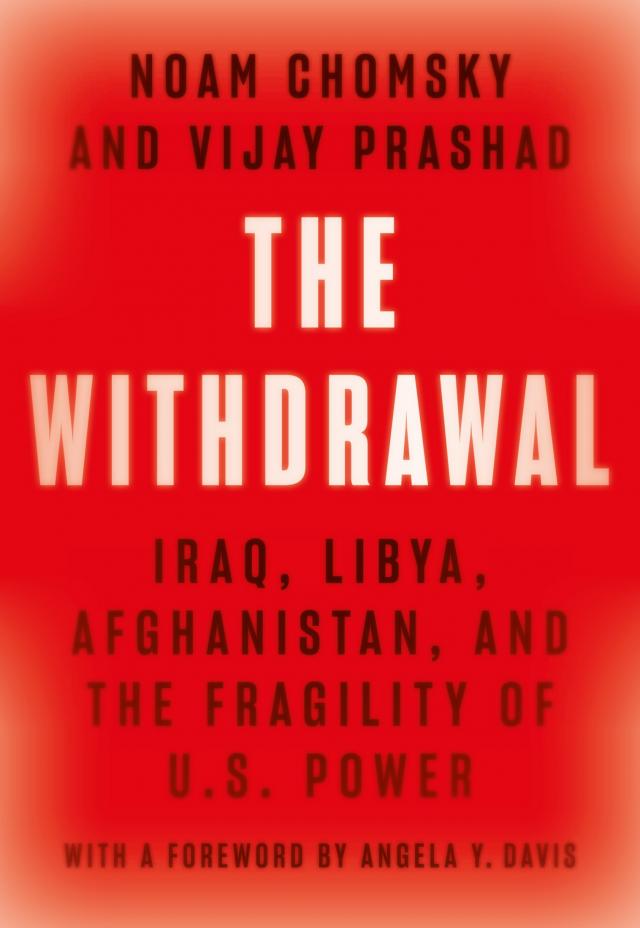
THE WITHDRAWAL
IRAQ, LIBYA, AFGHANISTAN, AND
THE FRAGILITY OF U.S. POWER
NOAM CHOMSKY
AND VIJAY PRASHAD
Contents
Foreword by Angela Y. Davis
Introduction
Vietnam and Laos
9/11 and Afghanistan
Iraq
Libya
Fragilities of U.S. Power
Afterword
Notes
Foreword
For almost as long as I can remember, Noam Chomsky has served as the conscience of a country whose government consistently engages with those parts of the world outside its own sphere of influence by either deploying violence or threatening to do so. Even when we in the United States have endured profound domestic crises, Chomsky has always insisted that we also turn our attention outwards, to avoid capitulating to the assumption that the nation-state, within whose boundaries we happen to live, is the most important political presence of our lives. He has always counseled us to reject American exceptionalism. His germinal essay “The Responsibility of Intellectuals” resonates today more than ever, especially as we collectively make great efforts to address a range of questions regarding the ways racism—and indeed racial capitalism—has structured the social, political, and cultural institutions that define our collective lives in the U.S. He reminds us that there is a geopolitical and historical context to this work. As his collaborator Vijay Prashad also insists, the impact of colonialism and the role of the slave trade and slavery in the development of capitalism have had lasting effects not only in the U.S. but indeed throughout the world.
Although I have been reading Noam Chomsky for decades and have attended his lectures on too many occasions to count, my first opportunity to meet him in person was not until December 2012 when he, Vijay, and I participated in a program at the Berklee College of Music organized by Rachel Herzing and Isaac Ontiveros, representing Critical Resistance (CR). This event was a fundraiser benefiting CR, the LGBTQI prison abolitionist organization Black and Pink, and the City School in Boston, which develops youth leadership for social justice. I retain a particularly vivid memory of this event because just days earlier I came down with a nasty case of the flu and seriously wondered whether I should make the trip to Boston. (Given our experience with the COVID-19 pandemic over the last two years, I now realize I should have probably stayed at home.) But my sense then was that I could not miss the opportunity to meet this historic figure, who had taught me and the world so much about the “responsibility of intellectuals.” It was a phenomenal event, and though I have little memory of my own contributions, I remember being absolutely captivated by the evening’s conversations that unfolded under the rubric “Radical Futures and Prospects for Freedom.” Our discussion evoked the prison industrial complex as a discernible product of the post-slavery history of the U.S. and of global capitalism as it has developed since the 1980s, and the three of us talked about lessons for abolitionist resistance drawn from anti-imperialist struggles and prospects for the future of internationalism.
I was impressed, as I always am, not only by the immensity of Chomsky’s command of history and analysis, especially regarding the incalculable wreckages originating with the U.S. military, but also by his unpretentious presence. On this cold Boston night, after the event and reception had concluded—I think it was close to 11 p.m.—he prepared to leave. Someone asked him about his ride and he responded that, as usual, he would find his way home by bus. Of course half of the people there then volunteered to drive him home. But he never thought of himself as so special as to merit this treatment.
Over the decades during which generations of scholars and activists have been influenced by Chomsky’s books, interviews, and lectures—indeed he is our country’s preeminent public intellectual—he has always attempted to bring to light the hidden violences, those that are so often assumed to be simply collateral consequences that hardly merit recognition. For instance, he often emphasizes the point that there is a vast discrepancy between the numbers of Vietnamese people who were actually killed during the war (2 million officially acknowledged, but probably 4 million in reality), and the diminished numbers inscribed in our historical memory (in polls and studies, people typically imagine only 100,000 killed as an average). This disturbing difference between fact and perception serves as an example of the ways in which the state-ordered, brazen slaughter of human life can be so cavalierly minimized under the impact of U.S. ideology.
This most recent collaboration with Vijay Prashad continues to explore the theme of ugly wars conducted by the United States. I have long appreciated Vijay’s insistence on the need for people inside progressive circles to generate a sharper sense of our situatedness within global struggles. Through the structure of a deeply engaging conversation between two of our most important contemporary public intellectuals, we are urged to defy the inattention of the media to the disastrous damage inflicted in Afghanistan on life, land, and resources in the aftermath of the U.S. withdrawal and the connections to the equally avoidable and unnecessary wars on Iraq and Libya. Thank you, Noam and Vijay, for this insightful book which emphasizes the continuities, across time and political parties, of official policies and practices that produce and reproduce these militaristic incursions and offers us the kind of internationalist perspective that is our best chance for the future the world needs.
—Angela Y. Davis
Introduction
The Legacy of Ugly Wars
On August 15, 2021, the United States military had to withdraw from Afghanistan after a twenty-year occupation. Little good remained in place as the Taliban entered Kabul and took control of what remained of the Afghan state. The death toll from this war is contested, but few dispute that a few hundred thousand people have perished under fire (a United Nations study found that at least 40 percent of civilians killed by air strikes were children). The Afghan Ministry of Public Health estimates that two-thirds of Afghans suffer from war-induced mental health troubles. Half of the population lives below the poverty line, and about 60 percent of the population remains illiterate. Few gains were made on these fronts.
Meanwhile, the Taliban found that the coffers in the Central Bank’s offices in Kabul were empty; the reserves—$9.5 billion—sat in U.S. banks, from which they were now seized by the United States to pay off the families of victims of the 9/11 attack. During the U.S. occupation, Afghanistan relied for its revenues on foreign aid, 43 percent of Afghan GDP in 2020. This collapsed as the United States withdrew; the UN Development Programme calculates a drop in the GDP because of the loss of foreign aid to be 20 percent (2021) and then 30 percent in the following years. Meanwhile, the United Nations estimates that by the end of 2022 the country’s per capita income may decline to nearly half of 2012 levels. It is estimated that 97 percent of the Afghan people will fall below the poverty line, with mass starvation a real possibility. It was telling that the last drone strike by the U.S. military on Afghan soil struck a car carrying ten people, including seven children and Zemari Ahmadi, who drove a car for Nutrition & Education International (a Pasadena, California–based charity). The U.S. military first suggested that Ahmadi was an ISIS member, and took two weeks to acknowledge that the Reaper drone had killed civilians; no troops have been punished for this crime.
This is the nature of the ugly wars of the United States.
In recent years, the United States has failed to accomplish any of the objectives of its wars. The United States entered Afghanistan with horrendous bombing and a lawless campaign of extraordinary rendition in October 2001 with the objective of ejecting the Taliban from the country; now, twenty years later, the Taliban is back. In 2003, two years after the United States unleashed a war in Afghanistan, it opened an illegal war against Iraq, which ultimately resulted in the start of an unconditional withdrawal by the United States in 2011 after the refusal of the Iraqi parliament to allow U.S. troops extralegal protections. As the United States withdrew from Iraq, it opened a terrible war against Libya in 2011, where—as discussed later—France was in the lead, Britain behind, and then the United States eventually took over. This war resulted in the creation of chaos in the region.
Not one of these wars—Afghanistan, Iraq, Libya—resulted in the creation of a pro-U.S. government. Each of these wars created needless suffering for the civilian populations. Millions of people had their lives disrupted, while hundreds of thousands of people lost their lives. What faith in humanity can now be expected from a young person in Jalalabad or in Sirte? Will they now turn inward, fearing that any possibility of change has been stolen from them by the barbaric wars inflicted upon them and other residents of their countries?
There is no question that the United States continues to have the world’s largest military and that by using its base structure and its aerial and naval power it can strike any country a t any time. But what is the point of bombing a country if that violence attains no political ends? The United States used its advanced drones to assassinate Taliban leaders, but for each leader that it killed, another half-dozen have emerged. Besides, the men in charge of the Taliban now—including the cofounder of the Taliban and head of its political commission, Mullah Abdul Ghani Baradar—have been there from the start; it would never have been possible to decapitate the entire Taliban leadership. More than $2 trillion has been spent by the United States on this war, in which U.S. triumphalism reigned from the start.
In early statements after the U.S. withdrawal from his country, Mullah Baradar said that his government would focus its attention on the corruption endemic in Afghanistan. Meanwhile, stories spread across Kabul about ministers of the last U.S.-friendly Afghan government, led by former World Bank official Ashraf Ghani, who attempted to leave the country in cars filled with dollar bills, which was the money that had been provided by the United States to Afghanistan supposedly for aid and infrastructure. The drain of wealth from the aid given to the country has been significant. In a 2016 report by the U.S. government’s Special Inspector General for Afghanistan Reconstruction (SIGAR) relating to the “Lessons Learned from the U.S. Experience with Corruption in Afghanistan,” the investigators write: “Corruption significantly undermined the U.S. mission in Afghanistan by damaging the legitimacy of the Afghan government, strengthening popular support for the insurgency, and channeling material resources to insurgent groups.” SIGAR created a “gallery of greed,” which listed U.S. contractors who had siphoned aid money and pocketed it through fraud. More than $2 trillion has been spent on the U.S. occupation of Afghanistan, but it went neither to provide relief nor to build the country’s infrastructure. The money fattened the wallets of the rich in the United States, Pakistan, and Afghanistan.
Corruption at the very top of the government depleted morale below. The United States pinned its hopes on the training of 300,000 soldiers of the Afghan National Army (ANA), spending $88 billion on this pursuit. In 2019, a purge of “ghost soldiers” in the rolls—soldiers who did not exist—led to the loss of 42,000 troops; it is likely that the number was higher. Morale in the ANA has plunged over the past few years, with defections from the army to other forces escalating. Defense of the provincial capitals was also weak, with Kabul falling to the Taliban almost without a fight. To this end, the last defense minister of the Ghani government, General Bismillah Mohammadi, commented on Twitter about the governments that have been in power in Afghanistan since late 2001, “They tied our hands behind our backs and sold the homeland. Damn the rich man [Ghani] and his people.” This captures the popular mood in Afghanistan at the time the United States departed.
The Godfather
In each of these wars—Afghanistan, Iraq, Libya—the possibility of a negotiated settlement lingered at the edge of the conflict. In Afghanistan, the Taliban understood the gravity of a U.S. attack after 9/11 and made it clear on several occasions that it would be prepared to hand over Osama bin Laden and the al-Qaeda network to a third country. The Taliban had already experienced a small U.S. attack in 1998 against targets in Khost, so they were familiar with the awesome power of the United States military. Their plea for a settlement was rejected. Saddam Hussein’s government understood in 1990 that it had made an error in invading Kuwait, and it wanted to cut a deal with the United States to exit Kuwait without total humiliation; all attempts by the Iraqis to negotiate their withdrawal were met with disdain by the United States, which bombed Iraq heavily in 1991.
That is why Saddam Hussein was eager to make every concession to the United States in the aftermath of 9/11, allowing more and more UN inspections—whose inspectors found no weapons of mass destruction—and offering every means for the United States to verify that Iraq had no ill intentions toward the United States. Once more, Washington set aside the pleas from Baghdad and proceeded with its campaign, called Shock and Awe. In Libya, the government was eager to accept a peace plan laid out by the African Union, whose mission was prevented from going to Tripoli by NATO bombing, and then when it went there during the bombing and Muammar Qaddafi accepted its terms, the rebels with their advantage of NATO allies refused to accept the peace deal. The evidence is clear that the United States simply did not want to seek any peace agreement or even a preemptive surrender. When the United States wants war, it gets a war.
There is a mafia quality to the way the United States has exercised its power, something that goes back to the days of the genocide against the indigenous peoples of North America, who tried to negotiate with the settlers but faced instead the machine gun. When Chief Tecumseh of the Shawnee tried to negotiate with Indiana governor William Henry Harrison in 1811, the United States government used military force to chase Tecumseh to Canada; Harrison became the president of the United States, winning a reward for seizing the land. This attitude is rooted in a settler–colonial culture that expanded the initial Atlantic seaboard–based United States into the territory of Native American societies, seizing a third of Mexico, and then French and Russian territories in the Gulf Coast and California. Once the territorial United States had been established, all by the gun, the armies gathered to seize far-off archipelagoes and islands (Hawaii, Guam, Puerto Rico, Philippines) as well as to establish dominion through the 1823 Monroe Doctrine of the American hemisphere. During the U.S. war on the Philippines in 1898, General Jacob Smith ordered his troops to “kill everyone over the age of ten” and create a “howling wilderness.” A half-century later, in Vietnam, a U.S. helicopter team painted the slogan “Death is our Business and Business is Good” on the side of their quarters. The landscape had to be pacified, or else destroyed. The ethos here was defined by Lyndon B. Johnson, the U.S. president, who said, “It’s silly talking about how many years we will spend in the jungles of Vietnam when we could pave the whole country and put parking stripes on it and still be home by Christmas.” The idea that the United States—a city on the hill (a phrase from the Bible used by John Winthrop in 1630 to describe his new country as a “beacon of hope” for the world)—had a right to define the destiny of the Americas and to export this attitude to other lands, especially in parts of Africa and Asia, derives from its settler–colonial history.
World War II devastated most advanced industrial countries—certainly Europe, Japan, and the USSR; the United States, in contrast, saw none of its industrial base impacted. In fact, the war production enhanced industry in the United States, and the U.S. financial surplus gave the dollar a divine character not available to any other currency, not even the pound sterling. It was in this context that the United States began to aggressively define the path for its allies in Europe and Japan as well as to use every means necessary to subordinate the decolonization movement and to demonize the USSR through the Cold War system, which was imposed largely by the United States. Coups and military interventions define the Cold War era, from the United States–led coup in Iran (1953) to the U.S. military intervention in Iraq (1991). During these forty years, the United States’ force was somewhat held in check by the presence of the Soviet Union and its allies, as well as by the emergence of the Third World as a political force. Nonetheless, the United States operated in total disregard for international law; U.S. military and diplomatic power and the operation of multinational corporations domiciled in Europe, Japan, and the United States could not be checked.
The Godfather attitude expanded geometrically after the collapse of the USSR, when the United States’ ruling elite understood that they were the sole superpower. Benchmarks for this new era were the U.S. war in Iraq (1991) and the creation of the World Trade Organization (1994), the former a pure exercise of U.S. military power and the latter an institution by which to capture countries in a trade framework that the United States hoped to dominate. The U.S. wars against Afghanistan (2001) and Iraq (2003) came with little consideration for world opinion, even less for the possibility of preventing war through negotiation. The United States, as first among unequals, felt that it needed to answer to nobody. That’s the Godfather attitude. It is how we see the United States in this book.