On cuba, p.1
On Cuba, page 1


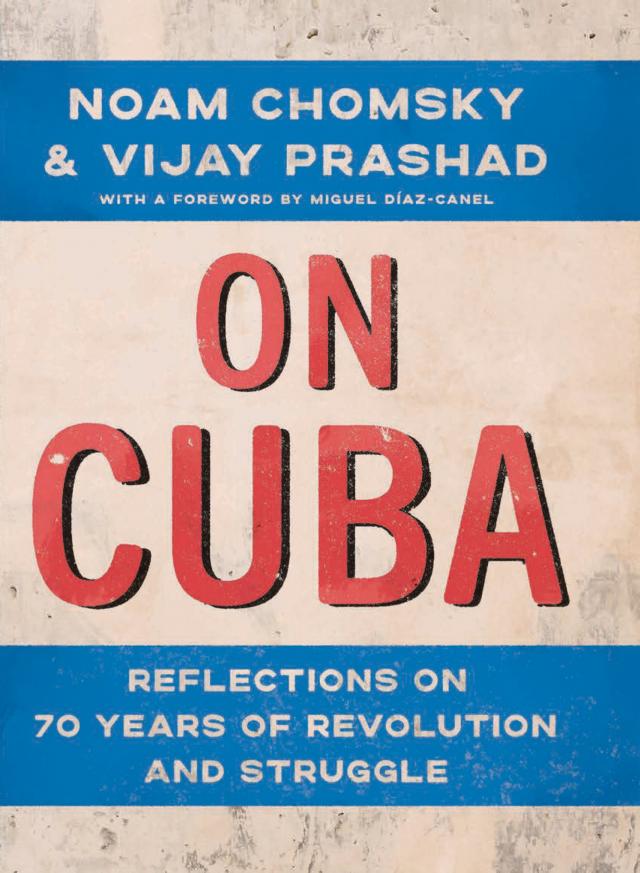
ON CUBA
REFLECTIONS ON 70 YEARS OF
REVOLUTION AND STRUGGLE
NOAM CHOMSKY
AND VIJAY PRASHAD
Contents
Authors’ Note
Foreword
Introduction
On Cuba
Afterword
Notes
Authors’ Note
Our Essay on Cuba
On Cuba is not really about Cuba itself, but it is about the suffocation that the United States has tried to implement against Cuba. This suffocation is based on material interests, certainly, but centrally on the need by the U.S. government to destroy any defiance of its role in the world and on a culture of cruelty that has set in among high officials of the U.S. government against Cuba. The word “defiance” comes up repeatedly in U.S. policy documents and in statements by U.S. officials when they talk about Cuba, documents and statements that we quote extensively in this book. Anger at this defiance has built a culture of cruelty toward the Cuban Revolution, and consequentially toward the people who live in Cuba. This cruelty is illustrated by casual statements by these officials, such as when U.S. Secretary of State Alexander Haig told President Ronald Reagan in March 1981, “Just give me the word and I’ll turn that fucking island into a parking lot.” The records show that Reagan was “tempted.”1
Despite the intensity of the U.S. campaign to overthrow the Cuban Revolution and despite the grave difficulties of building any kind of project in an island that has been embargoed by the most powerful country in the world since 1960, the Cuban people have resisted. We cannot think of another case like this in world history of a small country, practically engulfed by the world’s most powerful state, which is trying to destroy it, yet managing to survive—and not only survive but succeed in many ways. The health statistics in Cuba are better than those in the United States, a fact discussed only in professional journals, if at all, and not among the general public. In his 2007 documentary Sicko, Michael Moore did dramatize the difference in health care between the United States and Cuba. Moore traveled to Cuba with 9/11 rescue workers. They go to Guantánamo and walk to the entrance of the U.S. detention camp, where the United States government held detainees from its Global War on Terror. Moore, through a megaphone, begs the officials at this camp—a massive human rights violation by itself—to allow the 9/11 rescue workers to get the same medical care as the detainees. It is great political theater. In Havana, the 9/11 rescue workers buy affordable medicines and medical treatment at the Hermanos Ameijeiras Hospital—which had been a bank in pre-Revolution Cuba—and then these workers are received at a Havana fire station, where they are treated as heroes. Rather than try to digest the implications of the film, the U.S. media (led by John Stossel of NBC News) went after Michael Moore and tried to prove that the section on Cuba in his film was misleading. Rather than investigate the implications of Moore’s film, the U.S. media merely tried to debunk it.
The U.S. government’s reaction to Moore’s documentary was even more crude. On January 31, 2008, the United States Interest Section in Havana sent a cable to the U.S. State Department to say that the Cuban government had suppressed Moore’s Sicko because they know “the film is a myth that does not want to risk a popular backlash by showing to Cubans facilities that are clearly not available to the vast majority of them.” When this cable was released by WikiLeaks, Moore responded on his blog that this cable is a “stunning look at the Orwellian nature of how bureaucrats for the state spin their lies and try to recreate reality (I assume to placate their bosses and tell them what they want to hear).” Rather than suppress the film, Moore continued, “The entire nation of Cuba was shown the film on national television on April 28, 2008! The Cubans embraced the film so much so that it became one of those rare American movies that received a theatrical distribution in Cuba. I personally ensured that a 35 mm print got to the Film Institute in Havana. Screenings of Sicko were set up in towns all across the country.”
____________
The health services in the United States are catastrophic. Even in major cities, but especially in the rural areas which are a total disaster, hospitals are collapsing. In many places, there are no medical services. If there was any minimal sanity, the United States would be inviting Cuban doctors to go to the rural areas in the United States.*
____________
The U.S. public is taught over and over again by the government and by the mass media that Cuba is an authoritarian state, that the people who live there are enslaved by communism, and that Cuba is a threat to the United States. None of these three propositions are true, and yet these falsehoods define the general U.S. public understanding of Cuba. Because of the overall framework against Cuba, the U.S. media cavalierly fabricates whatever they want in order to undermine Cuba in U.S. public opinion. For instance, in 2017, the U.S. government accused Cuba of a “sonic attack” on its diplomatic officials, a claim widely repeated verbatim in the U.S. press; six years later, a U.S. government intelligence review concluded that “foreign adversaries” are highly unlikely to have created the “Havana Syndrome,” a point that the Cuban government made in 2017 but that was discounted and barely reported.2 The stain of the original story remains. It sets the groundwork for the next ridiculous story, for instance about the construction of a Chinese military base in Cuba, which the Cuban government and the Chinese government denied immediately.3 A reporter from BreakThrough News traveled to Bejucal, where the Wall Street Journal said there was a base, and asked people if they knew anything about this base or had seen any Chinese people in the town. The residents of this small town said that they had not seen any Chinese military activity in Bejucal, but—as one resident said—“on 22nd street there is a Chinese family, but they have lived here since I was a child.” Another person said, yes, there are some people of Chinese descent in the town, one was a massage therapist in a gym: “they are Cuban Chinese,” he said, born in Cuba, one of them eighty years old and the other a hundred years old.4 None of these facts—least of all the voices of Cubans—are regarded in the midst of a dangerous frenzy. When a powerful country, with a grip over global information channels, crafts a lie, it stands; it is much more difficult to undo that lie, even when it is clear that the facts are ridiculous.
This book originates during an afternoon in Havana, when Vijay went to see the singer Silvio Rodríguez at his Estudios Ojalá to give him a copy of La retirada, the Spanish edition of our book The Withdrawal. It turns out that Silvio is an enormous fan of Noam, and so he gave Vijay a book about Cuban music that he had put together as a gift to Noam. This chance encounter led to a conversation between Noam and Vijay about Cuba, which morphed into a series of taped discussions that we adapted into a manuscript for this brief book.
Over the course of the first half of 2023, we had a series of Zoom calls about U.S. foreign policy and Cuba. Despite Noam’s busy schedule, these calls would drift over the course of several hours to touch on a range of subjects—from the Bay of Pigs attack to the placement of Cuba on the U.S. State Sponsors of Terrorism list—some of these conversations resulting in short articles and statements that we published during that time. Initially, we had planned to create a book based entirely on an edited version of this conversations: an interview book. Vijay prepared the lightly edited transcript, sent it to Noam, and in another conversation we realized that this book was not exactly what we wanted. We decided that the conversations had produced the conditions for us to write a different kind of book—a jointly written text, drawing from these conversations as well as our short articles and statements. A brief, jointly written book was the only way to honor our original vision. We went back and forth to discuss how to put the book together, using the transcripts of the conversations and unpublished texts that Noam sent Vijay. Vijay then used these materials to assemble a draft text, which both Noam and Vijay worked on until we had a suitable project to offer for publication. In each section of the book, you will find a short pull quote from Noam’s comments during our many hours of conversation. We spent a month discussing this manuscript, trying to find a way to best approximate our combined assessment of the complexities of the Cuban Revolution. Despite our different points of departure, we found unity in our view that the U.S. government has been vindictive toward the Cuban Revolution because it has successfully defied Washington and it has offered a socialist model for the rest of the Third World. That is the core argument of this book. The text below is a more refined version of that draft, edited by Marc Favreau and Ishan Desai-Geller. We are grateful to Manolo De Los Santos, who had accompanied us on the journey to produce the book, for his introduction. And we are immensely happy that the president of Cuba, Miguel Díaz-Canel, wrote the foreword to On Cuba. Díaz-Canel took over from Raúl Castro, who himself took the top job in Cuba from the remarkable Fidel Castro. Those are difficult shoes to fill, and in particular to fill them when U.S. vindictiveness is at such a high level. But Díaz-Canel wears the shoes well, including using them to walk around the island to explain to people the nature of their crisis and to gather their hopes together to continue their struggle.
* As mentioned below in the Authors’ Note, all pull quotes in the book come from Noam’s comments during our many hours of conversation.
Foreword
I am deeply grateful to have been invited to write a few brief lines for this book on the long and painful history of U.S. aggression toward Cuba. It is an honor to introduce the work of Vijay Prashad and Noam Chomsky, writers of different generations who each ennoble the mission of the intellectual in our time through their marriage of political conviction and sober analysis.
My good friend Vijay Prashad and I have had the pleasure of sharing ideas and forums in recent times, and I am a great admirer of his theoretical work at Tricontinental: Institute for Social Research. I have, of course, known and admired Noam Chomsky for many years too. His impressive contributions to linguistic and communication theory and his timeless works of social criticism like Manufacturing Consent are mandatory in universities around the world and need little introduction. But what stands out in my mind is the political ardor he has inspired in his readers the world over.
At least twenty years ago, I remember reading of a lecture Chomsky delivered at the World Social Forum in Porto Alegre, Brazil. I was astonished to discover that the lecture was held not in a classroom or conference hall, but in a soccer stadium which was completely overflowing with young people, attentive to his words and cheering him with the passion of fans. Or, put differently, with the passion that knowledge provokes.
In On Cuba, Chomsky and Prashad have joined forces to document and analyze U.S. imperial aggression against our heroic homeland. It is clear that they have approached this projecct with the spirit of respect and solidarity that has always defined their relationships with Cuba, and that they bring their trademark courage, honesty, and erudition to bear on the subject.
Indeed, we Cubans are forever grateful to Chomsky for some of the most comprehensive and accurate judgments on the U.S. blockade of Cuba. Several years ago, during an unforgettable visit to our country, he was asked to comment on the blockade. Strikingly, he was not satisfied with a simple condemnation. Instead, in just a few words he formulated an analysis that is as valid today as it was then. More recently, Chomsky and Prashad published an article picking up where Chomsky’s analysis above ends to denounce in no uncertain terms the inclusion of our country on the United States’ spurious State Sponsors of Terrorism list. In that valuable text, they remind U.S. President Joseph Biden that, despite more than sixty years of economic blockade, Cuba has been able to “overcome the indignities of hunger, ill-health, and illiteracy, the three social plagues that continue to trouble much of the world.”
It is for precisely this reason that I am honored to place my name—as a son of the Cuban people, as a passionate follower of the first Socialist Revolution of the Western Hemisphere, and as a student of the ideas of José Martí and Fidel Castro—next to those of two authors, activists, and radical thinkers who are among the the world’s foremost leftist intellectuals. Chomsky and Prashad have always defended our right to exist, develop, and prove that the struggles of humanity for its emancipation have not been in vain. A better world is possible. A Cuba free of blockade, harassment, and aggressions of all kinds could prove it.
—Miguel Mario Díaz-Canel Bermúdez
First Secretary of the Central Committee of the
Communist Party of Cuba and
President of the Republic of Cuba
Introduction
In 1959, the Cuban Revolution erupted onto the global stage, catching the world off guard. The island nation soon transformed into a hub for foreign journalists, eager students, and deep-thinking intellectuals, all determined to witness the unfolding social experiment with their own eyes. They were drawn to this Caribbean crucible of change like moths to a flame, all asking the question: what next?
The early 1960s saw a generation of intellectuals leaning toward the left, their gaze firmly set on Cuba’s burgeoning revolution. Amid the tumultuous vortex of the Cold War, they attempted to decipher the political trajectory of this small nation shaking off the shackles of imperialism. Among U.S. intellectuals, many sought to shield the Revolution from the aggression of their own nation, insisting that the Cuban Revolution was not the spawn of communism as its critics alleged. Simultaneously, by the middle of 1960, certain foreign observers such as Leo Huberman and Paul Sweezy, editors of the Monthly Review, had begun labeling the Cuban Revolution as “socialist,” even before Fidel himself publicly declared the term.
One of the curious minds that made this journey was C. Wright Mills, the revered sociologist from Columbia University. Known for his seminal studies on the American class structure in the aftermath of World War II, his works White Collar and The Power Elite had already established him as an astute observer of societal shifts. For two weeks in August 1960, Mills immersed himself in the Cuban experience, even spending three days journeying with Fidel Castro himself. His mission was clear: to pen a book that would capture the voices of the Cuban revolutionaries and articulate their aspirations to the world. Unlike his peers, Mills perceived the Cuban revolutionaries through a different lens. He saw them as Marxists, engaged in the monumental task of constructing a “socialism with heart” on an island that had long been the victim of underdevelopment.
The triumph of the Cuban Revolution in 1959 was met with a belligerent stance from the U.S. government. Despite initially acknowledging the government of the newly inaugurated president Manuel Urrutia a mere week after the revolutionaries had dethroned the oppressive regime of Fulgencio Batista, the U.S. proceeded to sabotage the Cuban Revolution, especially after Fidel Castro was elevated to the position of prime minister in February 1959. When Castro sought to visit the United States in April, President Dwight Eisenhower declined to meet him. This marked the beginning of a steady decline in relations, culminating in the United States severing ties with Cuba in 1961 and implementing a series of destabilizing tactics coordinated by the CIA: from over six hundred assassination attempts on Castro to terrorist activities under Operation Mongoose on the island and the Bay of Pigs invasion by right-wing Cuban exiles. With these insidious acts, the U.S. immediately set the tone for official policy toward the new, revolutionary Cuba. In 1962, the Kennedy administration initiated a blockade against Cuba, launching a relentless campaign of starvation and deprivation against the island’s 11 million inhabitants that still chokes the island to this day.
However, it was not the people of the United States who condemned Cuba, despite the actions of their government. Just after the Revolution’s victory, two potent sociopolitical forces within the United States—the Black liberation movement and socialist organizations—immediately rallied behind the Cuban Revolution.
When Castro journeyed to New York to participate in the 1960 UN General Assembly meeting before the U.S. had officially cut off ties with Cuba, he and his delegation were kicked out of their accommodations and left without a place to stay. Malcolm X stepped in and arranged for the Cuban delegation to lodge at Hotel Theresa in Harlem, a gesture that showcased the profound connections between the Black liberation movement and the Cuban revolutionaries across the sea. When Eisenhower denied Castro entry to his luncheon with other Latin American leaders, Castro responded by hosting his own gathering at a Harlem coffee shop for Hotel Theresa’s employees, whom he referred to as “the poor and humble people of Harlem.” In a meeting between Castro and Malcolm X, the latter affirmed, “there are 20 million of us and we always understand,” highlighting the solidarity of the revolutionary process.
In March 1960, Leo Huberman and Paul Sweezy undertook a journey to Cuba to witness the Revolution firsthand. They interacted with key revolutionaries (Castro and Che Guevara), state officials, new civic bodies, and everyday Cubans. Upon their return to New York, Huberman and Sweezy published their observations in a special issue of their socialist publication, entitled “Cuba: Anatomy of a Revolution.” Later that year, they released their report as a book with Monthly Review Press. This book was among the earliest to argue that the Cuban Revolution—fueled by its fierce commitment to sovereignty—was naturally evolving in a socialist direction. Huberman and Sweezy revisited the Revolution several times, with Huberman’s Socialism in Cuba (1960) becoming highly regarded on the island for its empathetic critique of the Cuban process. The relationship between Monthly Review (the press and the magazine) and the Cuban Revolution has been enduring and significant.