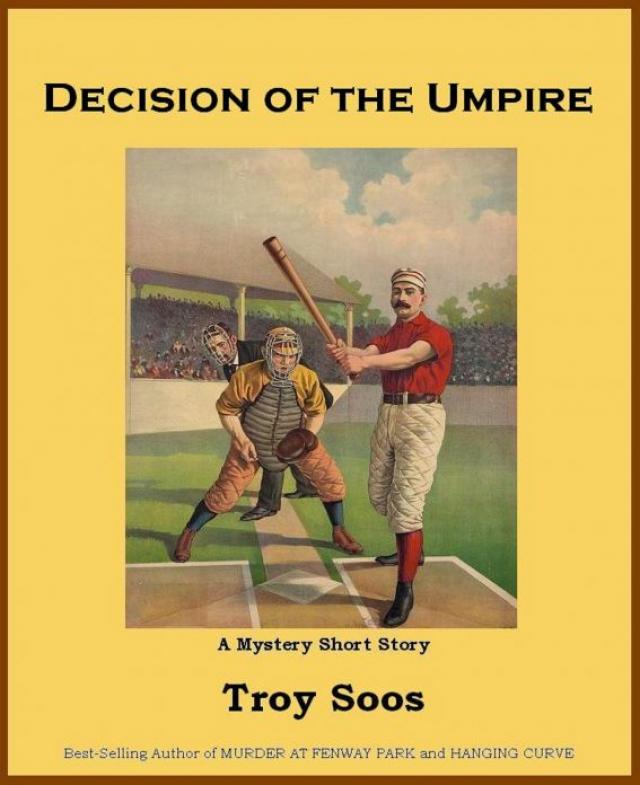
Decision of the umpire, p.1
Decision of the Umpire, page 1


Reviews of Troy Soos’s Mystery Novels
“Full of life.” – New York Times
“Baseball and mystery team up for a winner.” – USA Today
“A richly atmospheric journey through time.” – Booklist
“Rawlings turns double plays and solves murders with equal grace.” – Publishers Weekly
“An entertaining double play. . . The plot will appeal to mystery fans, baseball purists will appreciate Soos’s attention to detail.” – Orlando Sentinel
“A perfect marriage between baseball and mystery fiction.” – Mystery Readers Journal
“You don’t have to be a baseball fan to love this marvelous historical series.” – Meritorious Mysteries
“Equal parts baseball and mystery are the perfect proportion.” – Robert B. Parker
“Authentic old-time baseball atmosphere and absorbing stories. Troy Soos captures the period perfectly.” – Lawrence Ritter, author of The Glory of Their Times
Decision of the Umpire
Troy Soos
Published by Troy Soos at Smashwords
Copyright 2012 Troy Soos
Smashwords Edition, License Notes
This ebook is licensed for your personal enjoyment only. This ebook may not be re-sold or given away to other people. If you would like to share this book with another person, please purchase an additional copy for each recipient. If you’re reading this book and did not purchase it, or it was not purchased for your use only, then please return to Smashwords.com and purchase your own copy. Thank you for respecting the hard work of this author.
Decision of the Umpire
Duke Seaton paced the infield of Baltimore’s Union Park like a prison guard patrolling an exercise yard. The old umpire was alone on the diamond today, but he knew that in twenty-four hours he would indeed have to be every bit as vigilant as a law officer.
At that time would begin the first game of the Temple Cup series to determine the world’s champion baseball team. There would be clamorous fans packing the double-decked grandstand, newspaper reporters from all over the country on hand to record the action, and, running amok on the basepaths, the wildest band of hooligans ever to wear the uniforms of baseball players: the Baltimore Orioles.
It was unfortunate, Seaton felt, that Baltimore was to be one of the teams involved in the championship series. John McGraw, Wee Willie Keeler, and their Oriole teammates routinely trampled under their spiked shoes the ideals that Seaton cherished: fair play, respect for tradition, and good sportsmanship. As Seaton’s tattered shoes could attest, they frequently stomped the feet of the men charged with enforcing the rules as well.
League officials had at least lightened the officiating burden by assigning a second umpire to the best-of-seven series. While Seaton called balls and strikes, junior umpire Harry Travis would handle the bases. The extra eyes gave them a fighting chance of making John McGraw and his accomplices play by the book.
Seaton’s inspection of the grounds was an extra precaution toward that end. Although the Orioles were notorious for abuses such as tripping base runners and flashing mirrors at the eyes of opposing batters, they also had more subtle tricks that involved the Baltimore groundskeeper. The field had been doctored, Seaton noticed, but he would wait until game time to remedy it.
Absently stroking his silver muttonchops, Seaton paused to look at the flagpole on the grandstand roof. Stretched taut by a stiff October breeze was a shimmering black banner with orange lettering that proclaimed:
BALTIMORE ORIOLES
Champions of Baseball 1894
The flag had been hoisted days before, when the regular season ended. The Baltimore club claimed that because they had won the National League pennant they would remain champions no matter the outcome of the Temple Cup games. The team they were to face in the series, the second-place New York Giants, had a different opinion.
The meaning of the championship games was only one of many recent disputes. After clinching the pennant, the Orioles threatened to boycott the series unless they received a larger share of the gate receipts. In response, the Cup’s donor vowed to take back the solid silver trophy if the terms were changed. Then came stories that players of both teams were making side deals to split the winnings, and darker rumors that gambling elements had taken an interest in the games. All the controversies only served to fuel public interest in the series, until it had by now become the most anticipated event in baseball history.
When Seaton returned to home plate, he stopped and gazed out over the field. He couldn’t control the off-field bickering, but what took place between the foul lines was under his rule. In a resonant baritone, he issued a practice cry of “Play ball!” and was pleased at the way it reverberated in the park. Seaton left the grounds in good humor, eagerly awaiting the next day when those words would start the ballgame.
During the carriage ride back to the Hotel Rennert, Seaton’s mood improved further as he thought of Amos Rusie, the twenty-three-year-old “Hoosier Thunderbolt” who was slated to pitch the opener for the New York Giants. Because of the ex-farmboy’s overpowering speed, the league had decided at the start of the season to increase the distance from pitcher to batter by more than ten feet—yet Rusie still went on to win thirty-six games. Although he was supposed to be always neutral, Seaton couldn’t help but delight in picturing the Baltimore hitters having to face Rusie’s devastating fastballs.
At the hotel, a supercilious desk clerk reached into a pigeon hole behind him and handed Duke Seaton a folded note sealed with a blotch of red wax. Seaton waited to read it until he was in the privacy of his room where he retrieved his spectacles—a closely guarded secret—from a bureau drawer. Peering through thick lenses, he broke open the note and held it at varying distances until its words came into focus. In a familiar scrawl was written: $200 if Rusie loses tomorrow. A broken neck if he wins.
* * *
George Hall finished drawing the beer with a flourish, crowning the mouth of the hefty mug with a perfect head of yellow foam. He slid it across the polished mahogany bar. “Here you go, Ferris.”
Ferris Potts downed half the contents in one long swallow.
“That’s a nickel,” Hall reminded him.
The hulking, pig-faced young man on the stool belched loudly. “Like hell it is.” He quickly drained the rest of the brew. “Gimme another.”
Hall was a healthy forty-five, only ten pounds over his ideal weight and with little gray in his black handlebar mustache. The rolled-up sleeves of his candy-striped shirt revealed thick, brawny forearms. In 1876, when Hall played left field for Philadelphia, those arms had powered five round-trippers to make him the National League’s first home run champion. But Ferris Potts was a professional thug whose hard muscles bulged beneath his knitted green turtleneck. Hall wasn’t about to fight him for the cost of a couple of beers. “On the house,” he said with practiced pleasantness, and moved to the tap.
Potts grunted in appreciation. He reached out a hand the size of a catcher’s mitt, grabbed a pickled egg left over from the free lunch spread, and popped it into his mouth whole.
The lunch crowd had dispersed more than an hour before, and the evening drinking had yet to begin, leaving the plush barroom of the Hotel Rennert nearly empty. Only two other customers remained: an ancient regular who was taking his customary afternoon nap and a morose tobacco dealer who’d been nursing the same bourbon and branch water for half an hour.
When Hall brought him the second beer, Potts asked, “Talk to him yet?”
“Not directly. It’s tough for me to make the approach in person, you know.”
A cruel smile twisted Potts’s face. “You mean it’s tough for him if he’s seen with the likes of you.”
“Yeah, that’s what I mean,” the bartender acknowledged. During the National League’s second season, while with the Louisville Grays, George Hall had been expelled from baseball for throwing games. That was seventeen years ago, but the banishment was a life sentence. He couldn’t even enter a professional ballpark as a paying customer. And anyone in baseball who associated with Hall ran the risk of being blacklisted as well.
“How much you get for that Louisville business again?” Potts delighted in asking the question every time he and the baseball pariah spoke.
“Twenty-five bucks,” Hall answered quietly.
Potts shook his head. “Damn, you went cheap.”
“In those days, that seemed like a lot of money.” But not nearly enough, Hall thought, to make it worth having to trade his baseball bat for a barman’s rag.
“And now Chaney’s gonna give you twenty-five for doing hardly nuthin’.” Potts shook his head again. “Don’t know why the man wants to throw good money away like that.”
“He seems to think I’m worth it.” Boyd Chaney, a high-stakes gambler interested only in sure things, had found a use for George Hall’s baseball experience. When Chaney wanted games fixed, he paid Hall to secretly approach players about throwing them. As a former ball player, Hall spoke their language and could more readily gain their trust.
Potts snorted with the sound of a rooting hog. “Chaney’d save himself a load of dough if he’d let me do things my way.”
Hall looked down the length of the bar. The old man was snoring peacefully and the tobacco salesman’s glass was still half-full. He turned back to Chaney’s enforcer. “And your way is?” Hall was fairly certain he already knew. It seemed that whenever Hall failed to persuade a ballplayer to go along with a fix, the player soo n suffered an injury.
“Simple,” said Potts. “Give the guy one choice: do what we tell him, or get hurt. No reason to pay him a cent.”
The business had certainly become more ruthless since ’77, thought Hall. Back then, it was a straight deal: accept the money and throw a ball game or turn down the offer and play to win. Then Boyd Chaney came along and introduced a carrot-and-stick approach: take the money and throw a game or turn it down and get a career-ending injury. Now Potts didn’t even want to let a player have the carrot. “I don’t think that’s the way to go,” Hall said.
“It’s my way.” Potts drained his beer. “And it’ll be Chaney’s if he has any sense.”
Without being asked, Hall stepped over to the tap again. He’d started working for Chaney because of the money—and in part to get some revenge against the game that had exiled him. But in time, as ballplayers who didn’t cooperate started getting hurt, Hall discovered that he cared less about money than he did about keeping the players safe. As Hall chose to look at it now, he was helping a player whenever he could convince him to take a bribe—helping to keep him from getting worked over by Ferris Potts, at least.
Hall brought Potts the fresh beer. Grinning at the prompt service, Potts tapped him on the arm with a forefinger the size of a sausage. In a confidential voice he asked, “You hear about that pitcher down in Richmond?”
“The one who got his hands smashed in a door couple months ago?”
“Yup.” Potts beamed. “That was my work. Shows we mean business: guy don’t do what he’s told, he gets hurt. Word gets around and soon we don’t gotta pay nuthin’ to nobody.”
Hall shook his head slowly. “This deal’s too big. You can’t go that route.”
Potts’s eyes receded into his round fleshy face. “Who the hell are you to tell me?”
The bartender spread his hands disarmingly. “Hey, I’m the expert on how these things can go wrong.”
Looking somewhat mollified, Potts let out a laugh. “I’ll say!”
“Tell you what,” Hall said. “Why don’t you get Mr. Chaney here? See what he thinks.”
“I’m handling this.”
“No skin off my nose.” Hall began wiping his bar cloth over the counter. “But he’s probably got a bundle riding on this series. Hate to be in your shoes if the deal goes bust.”
“Ain’t gonna go bust,” muttered Potts. Apparently unconvinced by his own words, though, he soon hoisted himself off the barstool. “I’ll be back.”
* * *
After twice reading Hall’s note, Duke Seaton put a match to it, tossed the flaming paper on the grate of the room’s small fireplace, and proceeded to change for dinner. Stripped down to his trousers, Seaton cleaned himself at the washstand and prepared to shave. His motions were mechanical, for although the note paper was now ashes its message remained burned in his thoughts.
Firmly gripping the imitation bamboo handle of his straight razor, he methodically honed the blade on a boar skin strop. He wished he could fully enjoy the anticipation of the extravagant dinner he and Harry Travis were going to have at Eutaw House. During the Temple Cup series, the league was paying all the umpires’ meal and hotel expenses, unlike the regular season when room and board came out of their meager salaries.
But a debate raged in Seaton’s head: would he give Amos Rusie a chance to win or not? The umpire’s hand trembled slightly as he lathered his chin and carefully shaved it clean.
While he toweled dry, an ivory correspondence card tacked next to the mirror caught his eye. His spectacles still on—Seaton didn’t dare risk shaving without them—he read words that he already knew by memory: Be the decisions of an Umpire what they may, they should be silently received and abided by to the end of time.
Penned in Seaton’s own meticulous block lettering, they had first appeared in the New York Clipper in the summer of 1860. That was when Zachariah Seaton—not yet able to grow the regal whiskers that later earned him the nickname “Duke”—first began umpiring. In those days matches were played between gentlemen’s clubs such as the Knickerbockers and Excelsiors, and it was considered an honor to serve as arbiter. Seaton, then a law student at Columbia, was proud to umpire some of those early baseball games wearing the traditional Prince Albert coat and silk hat. Although the gentlemen athletes always accepted his decisions without quarrel, Seaton cut the Clipper editorial from the newspaper and kept it in his coat pocket as proof of his authority. He carried it still when he left school to accept a lieutenant’s commission in the Union army. During four years of war, when there were respites from battle, he umpired games in the camps—often showing the newspaper snippet to soldiers who were less compliant about accepting his decisions than the Knickerbockers had been.
Seaton never returned to law school, choosing instead to pursue an umpiring career. In his view, not even a judgeship could compare with umpiring. A judge’s decisions, after all, could be overturned by higher courts. On the baseball diamond, Duke Seaton’s rulings were final.
When the yellowed clipping became too worn to read, Seaton copied it over in his own hand. In the thirty years since, he’d rewritten it a dozen times. As the game changed over those years—ruffians replaced gentlemen on the field, umpires became objects of scorn, spectators degenerated into bottle-throwing hordes—Seaton clung to his belief in that one simple sentence. It often seemed his only ally as he fought to maintain the integrity of the pastime he loved.
After erasing a smudge from his stiff celluloid collar, Seaton attached it to his good white shirt and finished dressing. Since the square-cut blue serge suit he wore during games had to double as evening clothes, he maintained the appearance of an umpire, the only difference in costumes being a derby instead of a short-billed cap.
He looked down and frowned at the condition of his shoes. His balmorals were so scarred from being trod upon by spikes of malicious ball players that polish could no longer hide the damage. But they would have to last the series: $2.90 for a new pair was more than he could afford at present.
Taking one last check in the mirror, Seaton combed his mustache down and fluffed his muttonchops out. After returning his spectacles to the drawer, he went down to the lobby to meet Harry Travis.
* * *
From his station behind the bar, George Hall had a clear line of sight into the Rennert lobby. He saw Duke Seaton alone near the cigar stand pulling nervously at his whiskers. It was strange how things were working out, the bartender thought. When he’d first approached Seaton about Chaney’s scheme a few weeks earlier, Hall had expected him to go to the police. As Hall remembered from his playing days, “The Duke” did have a law-and-order reputation. Seaton had shown no inclination to contact the authorities though—he had even commented on how futile that would be. And, after Hall had given him all the details, the venerable umpire indicated a willingness to be involved.
Hall’s view was blocked when Boyd Chaney swaggered into the empty bar room flourishing a silver-headed walking stick. Chaney was slimmer but not much shorter than Ferris Potts, who lumbered a respectful two steps behind his master.
Taking up a small carving knife, Hall deftly cut a lime in half. His attention shifted from Duke Seaton to the two men approaching him.
The dapper gambler parted two stools and stepped to the brass rail. A fresh carnation bloomed from the lapel of his three-button gray cutaway, and a silk Windsor scarf of pale blue was knotted around his throat. Chaney’s clean-shaven pink face and wavy blond hair gave him a deceptively innocent appearance. In a soft drawl, he said, “We got a problem here?”
“No. No problem, Mr. Chaney.” Hall knew that the behind the man’s dandified demeanor was the merciless heart of a buccaneer. He poured a generous slug of gin into a tumbler. “Just a little disagreement.”